
Blog
What Is a 3D Mouse and Who Actually Needs One?
Jul
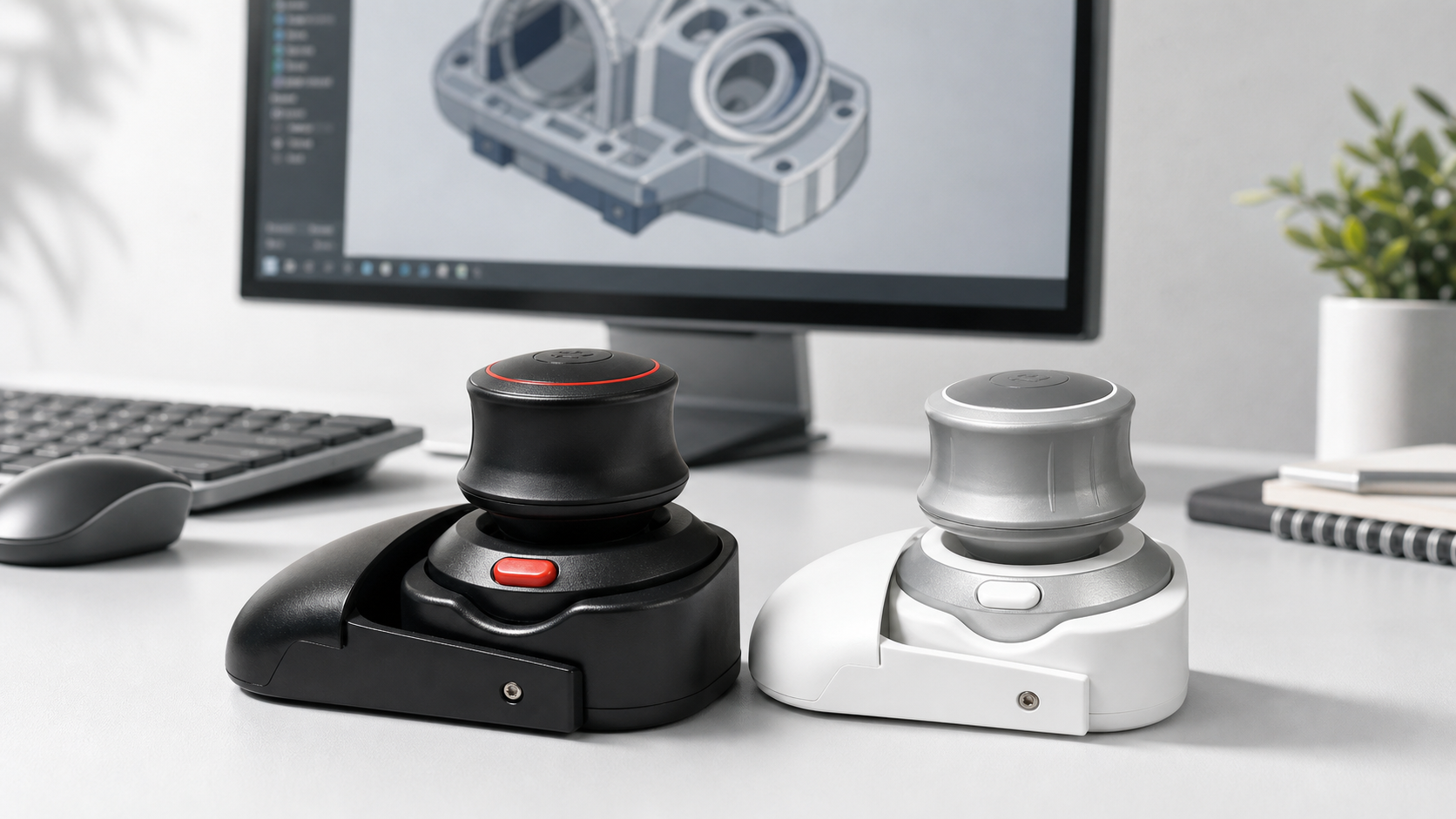
A 3D mouse is a second input device made for moving through three-dimensional space. Instead of driving the pointer across the screen, it controls the view around a model, assembly, scene, or map. Most users keep a normal mouse in their dominant hand for selection and commands, then use the 3D mouse with the other hand for pan, zoom, orbit, tilt, and rotation.
That distinction matters because many people first imagine a 3D mouse as a replacement for the regular mouse. In practice, it is closer to a navigation wheel for spatial work. The regular mouse still clicks edges, selects faces, drags sketch points, opens menus, and edits dimensions. The 3D mouse changes the camera so the thing you are editing is easier to understand.
What a 3D mouse actually controls
The central cap or puck on a 3D mouse usually responds to pressure in several directions. Push forward to move into the scene, pull back to move out, slide side to side to pan, twist to rotate, or tilt to change the viewing angle. The exact behavior depends on the software, driver, and sensitivity settings, but the goal is consistent: make view movement feel continuous instead of broken into repeated scrolls, drags, and shortcut presses.
This is why a 3D mouse is most common in CAD, mechanical design, product modeling, architecture, digital sculpting, and review workflows. If you regularly inspect geometry from several angles, navigate around a large assembly, or present a model to someone else, dedicated navigation can feel more natural than constantly switching between selection and viewport control. For a deeper comparison of the two devices, see 3D Mouse vs Regular Mouse for CAD.
How it works beside a regular mouse
A good mental model is two-handed work. One hand is the navigation hand and the other is the action hand. While the action hand selects a face, starts a command, edits a sketch, or checks a menu, the navigation hand keeps the model positioned. This reduces the start-stop rhythm that happens when the same mouse must both select geometry and constantly reframe the viewport.
The benefit is not that every task becomes faster immediately. The first few sessions can feel awkward because the hand is learning a new pressure-based control. But once the movement settles, the workflow can become calmer: rotate the part slightly, select a hidden edge, zoom closer, check the clearance, then move back out without losing the thread of the review.
Who gets the most value from one
The strongest candidates are people who spend meaningful time inside 3D views. Mechanical engineers, product designers, CAD students, makers, 3D printing users, Blender modelers, Revit reviewers, educators, and Google Earth users can all have a reason to test dedicated navigation. The shared pattern is repeated spatial movement, not a specific job title.
A hobby user who opens a model once a month may not need one. A student working through a semester of CAD assignments might benefit during project weeks but not during a lecture-heavy class. A freelancer who reviews client files every day may feel the difference quickly. The better question is not “Do professionals use this?” but “How often do I move through 3D space while trying to think about the design?”
When a normal mouse is still enough
A normal mouse is still the right tool for many workflows. If your work is mostly 2D drafting, document review, email, coding, or occasional model viewing, a 3D mouse may sit unused. It also will not fix a slow computer, a poorly built model, or software that does not support the navigation style you expect.
Budget matters too. If you are still learning the basics, you may get more value from a better keyboard, a larger monitor, a stable desk setup, or a structured practice routine. The beginner guide to using a 3D mouse for CAD navigation is a good next read if you want to see what the first practice sessions should look like.
Where the Wireless 3D CAD Mouse fits
The Wireless 3D CAD Mouse is a compact Bluetooth option for people who want to test dedicated 3D navigation without turning the desk into a large workstation. It makes the most sense when you already know that orbiting, panning, zooming, and presentation movement are part of your normal work.
Before buying, check your software workflow, operating system, desk space, and expectations. If you want a more purchase-focused checklist, read the wireless 3D mouse buying guide for CAD users.
Simple decision checklist
- You inspect 3D models, assemblies, scenes, or maps every week.
- You often interrupt selection work just to move the viewport.
- You present, teach, or review spatial designs with other people.
- You are willing to practice slowly for several sessions.
- You have checked software support and desk placement before buying.
FAQ
Is a 3D mouse the same as a CAD mouse?
Not exactly. A CAD mouse can simply mean a high-quality regular mouse used for CAD work. A 3D mouse is a separate navigation controller built specifically for moving through 3D space.
Can a 3D mouse replace my normal mouse?
For most users, no. It works best as a partner device. Keep the normal mouse for clicking, selecting, and editing; use the 3D mouse to control the view.
Does a beginner need a 3D mouse?
A beginner does not need one on day one. It becomes more useful once the user understands basic modeling commands and starts spending more time reviewing geometry from multiple angles.
What should I test first after buying one?
Open a simple project you already know. Practice slow orbit, pan, zoom, and return-to-view movements before judging whether the device feels helpful.
Final take
A 3D mouse is worth understanding because it solves a narrow but real problem: moving through 3D space while keeping your main pointer hand free for the actual work. If that problem appears in your workflow, it is a practical tool to evaluate. If spatial navigation is rare, a normal mouse is still enough.