
Blog
3D Mouse vs Regular Mouse for CAD: What Changes in Daily Work?
Jul
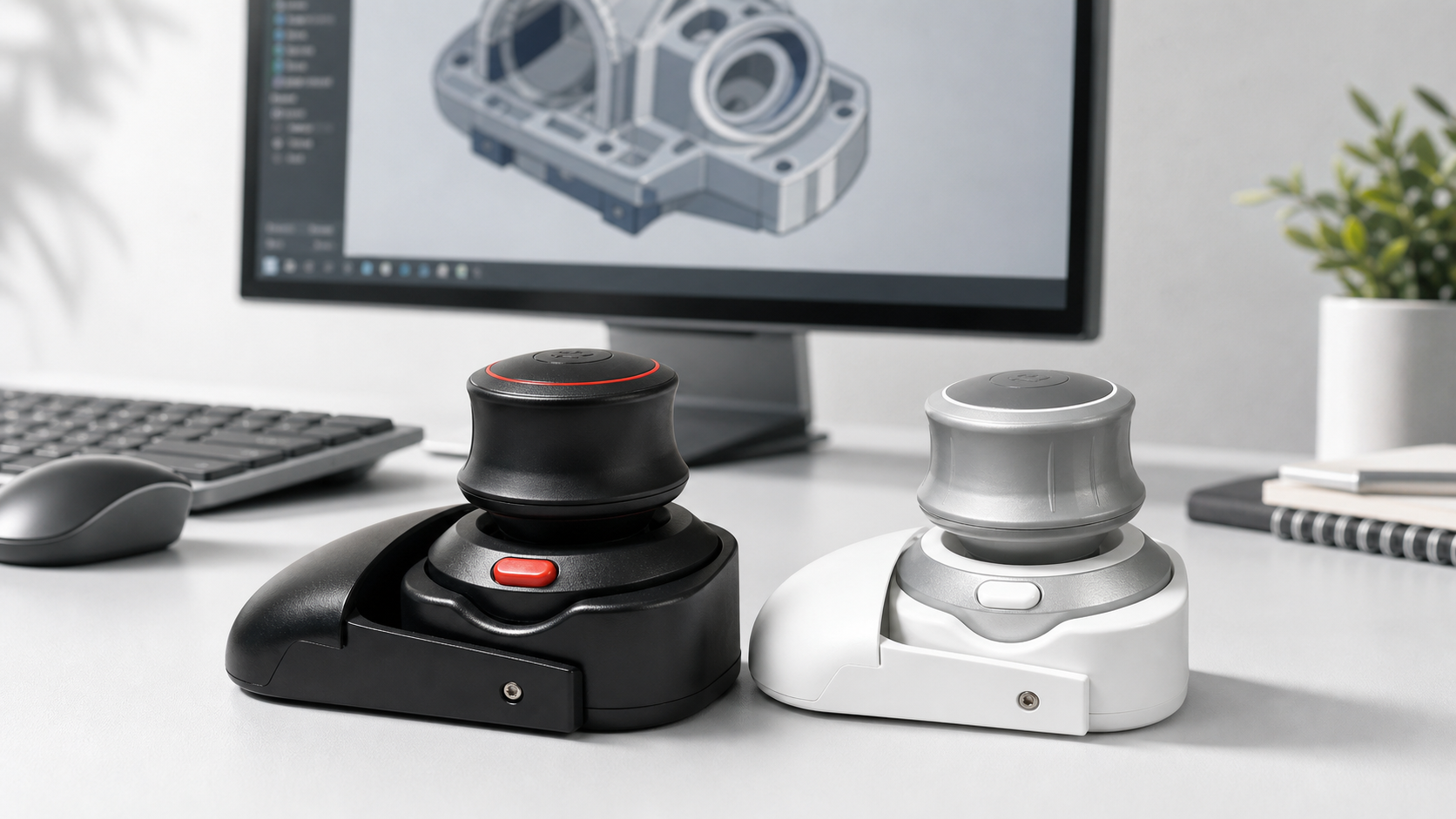
The difference between a 3D mouse and a regular mouse in CAD is not about which one is better at everything. It is about dividing two jobs that normally fight for the same hand. A regular mouse is excellent for pointing, selecting, sketching, dragging, editing, and using menus. A 3D mouse is built for moving the viewport around the part or assembly while those tasks continue.
That division is why experienced users often describe a 3D mouse as a workflow device rather than a simple accessory. It does not replace CAD knowledge, keyboard shortcuts, or a normal mouse. It changes how often you interrupt design thinking just to reposition the model.
The regular mouse is still the precision tool
In CAD, the regular mouse remains the device you rely on for exact pointer work. You still need it to select sketch entities, pick edges, drag handles, resize dimensions, open context menus, and confirm commands. If your work is mostly 2D drafting or light annotation, a regular mouse and keyboard may already cover almost everything you need.
A regular mouse also gives predictable behavior across every application. Even when a program has limited 3D navigation support, click and select actions usually work the same way. That makes the normal mouse the safer base tool, especially for beginners who are still learning the software interface.
The 3D mouse is the spatial movement tool
A 3D mouse takes over the view. Instead of scroll-wheel zooming, middle-button dragging, or repeatedly pressing shortcuts to rotate the model, you apply light pressure to move through the scene. The movement can be simultaneous: zoom while orbiting, pan while tilting, or rotate around a feature while keeping the selection hand ready.
This matters most when the model needs to be understood from several angles. Large assemblies, mechanical parts, product shapes, furniture models, architectural massing, and 3D printing checks all benefit from smoother inspection. If the question is “How does this geometry relate in space?” a 3D mouse can make the answer easier to see. For the basic definition, read what a 3D mouse is and who needs one.
How daily CAD work changes
The biggest change is rhythm. With only a regular mouse, the same hand often alternates between selecting and navigating. You select an edge, pause, drag the viewport, zoom, rotate, find the edge again, and continue. With a 3D mouse, the view can move while the regular mouse remains near the geometry or command you are working on.
This does not automatically cut every task in half. The first week is often slower because your navigation hand is learning how much pressure to use. Once the movement becomes predictable, the value shows up in small moments: fewer lost views, smoother model review, easier presentations, and less repeated scroll-drag-scroll behavior. The first-week learning curve guide explains what that adjustment period usually feels like.
Where keyboard shortcuts still matter
A 3D mouse is not a shortcut replacement. CAD users still need keyboard commands for sketches, features, constraints, view resets, measurements, and software-specific tools. In many workflows, the strongest setup is actually three-part: keyboard for commands, regular mouse for selection, and 3D mouse for the view.
Trying to move every action onto the 3D mouse can make the setup worse. Keep its job narrow at first. Use it for pan, orbit, zoom, and controlled review. Add buttons or custom commands only after the base movement is comfortable. This helps avoid the common beginner mistake of turning a navigation device into a confusing command pad.
Desk setup and buying tradeoffs
A regular mouse needs one clear working area. A 3D mouse needs a second reachable position, often on the opposite side of the keyboard from the normal mouse. Small desks can still work, but placement matters. If the device sits too far forward, too close to the keyboard, or at an awkward wrist angle, the benefit fades quickly.
The Wireless 3D CAD Mouse is aimed at users who want a compact Bluetooth controller rather than another large cabled device. It can be a sensible test if your main concern is clean desk layout, laptop use, or a small CAD workstation. For more on placement, see 3D mouse desk setup for small workstations.
FAQ
Is a 3D mouse faster than a regular mouse?
It can make navigation-heavy work feel faster, but it is not faster for selecting, sketching, or clicking. The advantage appears when you move around 3D models often enough for viewport control to become a real bottleneck.
Should beginners buy a 3D mouse first?
Usually not first. Learn the core CAD interface and basic shortcuts, then consider a 3D mouse when model navigation starts interrupting your work.
Do I still need keyboard shortcuts?
Yes. Shortcuts remain important for commands and repeat actions. The 3D mouse should reduce view-navigation friction, not replace the keyboard.
Which hand should use the 3D mouse?
Most right-handed users place it on the left so the right hand can keep the normal mouse. Left-handed users can reverse the setup if that feels more natural.
Decision guide
If your CAD day is mostly selecting, sketching, editing dimensions, and occasional orbiting, a good regular mouse may be enough. If you constantly inspect models from different angles, move through assemblies, present designs, or teach 3D concepts, a 3D mouse is worth testing. The best setup is not either-or. It is a regular mouse for precision and a 3D mouse for spatial control.