
Blog
Is a 3D Mouse Worth It for Hobby CAD Users?
Jul
A 3D mouse can be worth it for hobby CAD users, but only when the hobby has enough 3D navigation to justify a separate device. If you model once a month, a normal mouse and shortcuts are probably fine. If you spend several evenings a week checking parts, editing assemblies, preparing 3D prints, or learning product design, dedicated navigation can make the work feel less interrupted.
The decision is less about whether hobby work is “serious enough” and more about repetition. Tools earn their place when they remove a small annoyance that happens again and again. For CAD hobbyists, that annoyance is often the constant loop of rotate, zoom, pan, lose the view, reset, and try again.
Start with weekly modeling hours
A practical break-even test is time. If you only open CAD for occasional file viewing, buying a 3D mouse is hard to defend. If you model for five to ten hours a week, the value becomes easier to see because navigation is part of nearly every session. If you are building a portfolio, designing printable parts, modifying maker files, or learning a parametric CAD package, a smoother view can support the learning process.
Time alone is not enough, though. A hobbyist who spends hours on simple 2D sketches may not gain much. A hobbyist who spends fewer hours but constantly checks curved surfaces, clearances, assemblies, or STL export risks may feel the improvement sooner. The key question is how often you move through a 3D object while trying to make a design decision.
Compare it with other hobby CAD upgrades
A 3D mouse competes with other upgrades: a larger monitor, a better regular mouse, a mechanical keyboard, a drawing tablet, a faster computer, paid software, or learning materials. If your computer struggles to rotate the model, hardware performance should come first. If your desk is cramped, workspace organization may matter more. If you are still confused by basic constraints, a course or practice plan may beat any accessory.
But if the fundamentals are in place, a 3D mouse is one of the few upgrades that changes the physical feel of CAD work. It can make review sessions smoother and help you understand shape, proportion, and clearance without constantly fighting the camera. For buying context, see the wireless 3D mouse buying guide for CAD users.
Where hobby users notice the most benefit
3D printing is one of the strongest hobby use cases. Before exporting a model, you may check wall thickness, overhangs, mating surfaces, screw holes, and print orientation. Smooth orbiting makes it easier to inspect those details without losing the part. The same applies to RC parts, workshop fixtures, cosplay props, electronics enclosures, and replacement components.
Another good use case is learning. Beginners often struggle with the mental connection between the 2D screen and the 3D object. A 3D mouse can make exploration feel more physical, especially when the user practices slowly. It is not magic, but it can reduce the friction of looking around a model. The beginner navigation guide gives a good practice path.
When it is probably not worth it yet
Wait if your CAD time is rare, your projects are mostly 2D, or you are buying because the device looks professional rather than because you have a clear navigation problem. Also wait if you cannot place it comfortably beside your keyboard and normal mouse. A device that sits awkwardly on the desk becomes clutter, not a workflow improvement.
It is also reasonable to wait if you are still testing whether CAD is a long-term hobby. Spend a few weeks using view shortcuts, mouse gestures, and saved views first. If you keep noticing that view movement interrupts the fun part of designing, then a 3D mouse is a more informed purchase.
How the Wireless 3D CAD Mouse fits hobby budgets
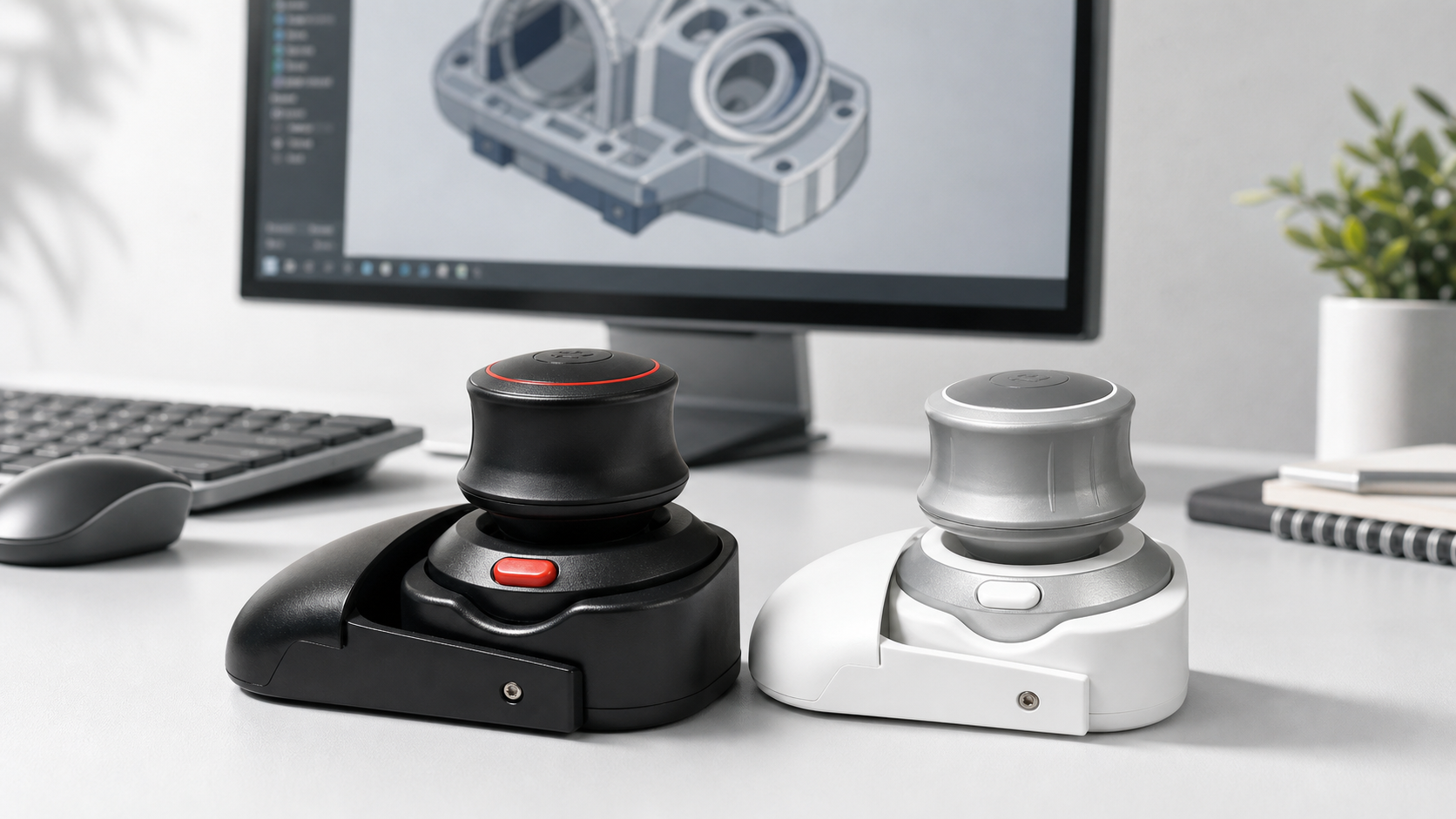
The Wireless 3D CAD Mouse is positioned as a compact option for people who want to try dedicated 3D navigation without building a full professional workstation. For hobby users, that matters because the device should not cost more attention, space, or setup effort than the problem it solves.
It makes the most sense when you already have a few real projects ready for testing. Do not judge it by spinning an empty cube for five minutes. Use a bracket, enclosure, model car part, printed jig, or furniture concept you already understand, then compare how the session feels with and without the controller.
FAQ
Is a 3D mouse overkill for hobby CAD?
It can be overkill for occasional users. It is not overkill if you regularly inspect 3D parts, prepare prints, or work on assemblies where navigation consumes real time.
Should I buy one before learning CAD shortcuts?
No. Learn the main shortcuts and view controls first. A 3D mouse is easier to evaluate when you know what workflow problem it is supposed to solve.
Can it help with 3D printing projects?
Yes, especially during pre-print checks. Smooth orbit, pan, and zoom can make it easier to inspect clearances, wall thickness, overhangs, and hidden faces.
How long should I test it before deciding?
Give it at least a week of short sessions. The first day may feel strange, so judge it after practicing with real projects, not after the first awkward hour.
Practical verdict
A 3D mouse is worth it for hobby CAD users when the hobby has become frequent enough that navigation friction is no longer a minor annoyance. If CAD is occasional, wait. If CAD is part of your weekly creative routine, a compact 3D mouse can be a useful way to make modeling and review sessions feel more controlled.