
Blog
3D Mouse Desk Setup for Small Workstations
Jul
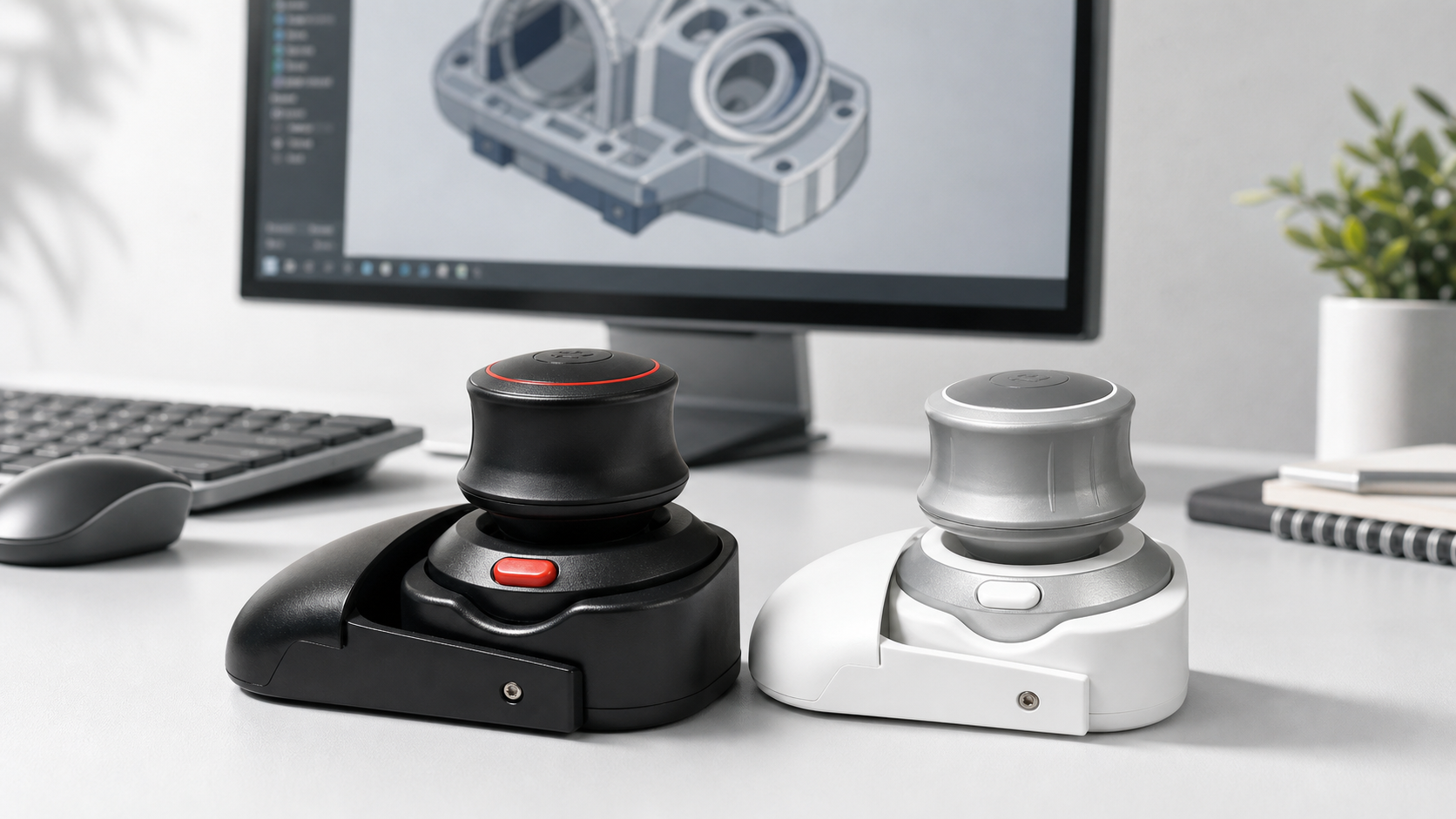
A 3D mouse desk setup does not need a huge workstation, but it does need deliberate placement. Small desks fail when every device competes for the same comfortable hand position. The 3D mouse, regular mouse, keyboard, laptop, notebook, tablet, and coffee cup cannot all own the prime area at once.
The goal is to create a layout where the navigation hand can rest naturally on the 3D mouse while the pointer hand still has enough room for selection. If either hand is reaching, twisting, or bumping into the keyboard, the workflow improvement disappears quickly.
Start with hand roles
Most CAD users keep the regular mouse in the dominant hand and place the 3D mouse under the other hand. A right-handed user usually puts the 3D mouse on the left side of the keyboard. A left-handed user may reverse that. The point is not a universal rule; it is keeping selection and navigation separate.
Before changing the whole desk, test the hand roles with a simple object. Put it where the 3D mouse would go and pretend to orbit while your regular mouse hand selects something on screen. If your shoulder lifts or your wrist bends sharply, the position is too far away or too angled.
Use the keyboard as the center anchor
On a small desk, the keyboard often controls the entire layout. A full-size keyboard with number pad can push the regular mouse too far right and leave no natural spot for a 3D mouse. A compact keyboard can create enough space for both devices without changing the desk.
Do not place the 3D mouse behind the keyboard unless you have very deep desk space. Reaching forward for every navigation move creates fatigue. A better position is usually beside the keyboard, slightly lower than shoulder width, where the hand can rest without stretching.
Keep the normal mouse area clean
The regular mouse still needs a clear selection zone. If the 3D mouse steals that space, CAD work becomes worse, not better. Keep the pointer hand free for edge selection, sketch editing, menu work, and precise clicks. The 3D mouse should reduce interruptions, not create a new obstacle.
This is why compact placement matters. The Wireless 3D CAD Mouse can fit setups where a larger controller would feel crowded. Wireless placement also helps when you need to shift the device slightly between laptop work, classroom use, or a shared table.
Plan for cables, tablets, and notebooks
Even a wireless 3D mouse lives in a larger ecosystem. Charging cables, external monitors, drawing tablets, notebooks, calipers, and 3D printed prototypes can all invade the same space. Decide what must stay on the desk during CAD work and what can move aside.
If you use a drawing tablet, place it intentionally rather than stacking it under the keyboard. If you take paper notes during design review, leave a narrow writing area outside the two-hand input zone. The cleanest setup is not the emptiest desk; it is the desk where every tool has a job and a repeatable place.
Small workstation practice routine
Once the desk is arranged, test the setup with a short workflow. Open a familiar model, place one hand on the 3D mouse, keep the other on the regular mouse, and perform a simple inspection: orbit the part, zoom to a feature, select an edge, reset the view, then repeat. If the device slides, catches a cable, or forces your wrist into a bend, adjust the placement before continuing.
Do this before judging the device itself. Many “I do not like 3D mice” reactions are really desk-placement problems. For movement practice, pair this article with the beginner CAD navigation guide.
Travel and laptop setups
For laptop CAD users, the easiest setup is often external keyboard plus two input devices. If that is not possible, place the 3D mouse on the side with the most stable flat area and keep the laptop trackpad disabled or ignored during CAD work. Wobbling surfaces make pressure-based navigation harder.
When traveling, carry only what you will actually use. A compact 3D mouse makes sense if you review models away from the main workstation. It makes less sense if the laptop barely has space for the normal mouse. The wireless 3D mouse setup checklist covers those pre-buy decisions.
FAQ
Which side should a 3D mouse go on?
Place it under the non-dominant hand for most CAD workflows. That keeps the dominant hand free for the normal mouse and precise selection.
Can I use a 3D mouse on a very small desk?
Yes, but placement must be deliberate. A compact keyboard, wireless device, and clear mouse area can make a small desk workable.
Should the 3D mouse sit above the keyboard?
Usually no. Above-keyboard placement often causes reaching. Beside the keyboard is usually more comfortable for repeated navigation.
Does wireless placement matter?
Yes. Wireless does not remove the need for a stable position, but it makes it easier to find a comfortable spot without cable routing problems.
Desk setup verdict
A good 3D mouse desk setup is about comfort, not decoration. Put the device where the navigation hand can rest, protect the regular mouse area, and test the arrangement on a familiar model. Small workstations can work well when each tool has a clear place.