Blog
How a 3D Mouse Fits Into a Two-Handed CAD Workflow
Jul
A two-handed CAD workflow uses one hand for view navigation and the other for selection, commands, and editing. The point is not to make the desk look advanced. It is to stop forcing one mouse hand to do every job: move the pointer, select geometry, rotate the view, zoom, pan, confirm commands, and then find the same feature again.
A 3D mouse makes the two-handed workflow easier because it gives the navigation job to a separate device. The regular mouse can stay close to the geometry being edited while the other hand keeps the model positioned.
The navigation hand controls the view
The 3D mouse hand should start with a narrow role: pan, orbit, zoom, tilt, and return to useful views. It should not try to handle every command during the first week. When the navigation hand has one clear job, the brain learns pressure and direction faster.
This separation is especially useful during inspection. You can orbit around a hole pattern, zoom into a clearance, or pan along an edge while the normal mouse remains ready to select a face or measurement point. For the basic movement vocabulary, see 3D mouse terminology explained.
The pointer hand stays focused on action
The regular mouse is still the action tool. It selects edges, opens menus, edits sketches, confirms dimensions, starts features, and interacts with the software interface. In a one-handed workflow, that same hand must constantly abandon selection to drag or scroll the view. In a two-handed workflow, selection and navigation can overlap.
This does not mean both hands are always moving. Good two-handed CAD often feels quiet. The view hand makes small corrections while the pointer hand completes the real work. The benefit is less interruption, not constant motion.
Keyboard shortcuts still belong in the system
The strongest setup usually has three parts: keyboard for commands, regular mouse for selection, and 3D mouse for navigation. Trying to replace the keyboard with device buttons too early can make the workflow harder to learn. Shortcuts are still excellent for repeated CAD commands and software-specific actions.
Start with simple boundaries. Use the 3D mouse for the view. Use the regular mouse for geometry and menus. Use the keyboard for commands you already know. After the base rhythm is stable, decide whether any buttons deserve custom shortcuts. The article on whether a 3D mouse can replace keyboard shortcuts explains why replacing everything is the wrong goal.
Where two-handed work helps most
The workflow is most useful when the model needs frequent repositioning. Mechanical part inspection, large assembly review, product design, 3D printing checks, architecture walkthroughs, and client presentations all involve repeated view changes. The more often you need to look around an object while thinking, the more a separate navigation hand can help.
It is less important for tasks that are mostly typing, 2D drafting, spreadsheet-like editing, or rare model viewing. If you are not moving through 3D space often, the second device may not earn its desk space. For a broader comparison, read 3D mouse vs regular mouse for CAD.
How to practice the workflow
Use a known model and choose one feature to inspect. Keep your regular mouse pointer near that feature. Use the 3D mouse to orbit slightly, zoom in, pan to re-center, then select or measure with the regular mouse. Repeat the same sequence several times until the view movement feels smaller and less dramatic.
Do not practice by spinning the model continuously. That teaches motion but not workflow. Real CAD navigation is often a chain of small corrections: move just enough to see the edge, select it, move just enough to see the next feature, then continue.
Where the Wireless 3D CAD Mouse fits
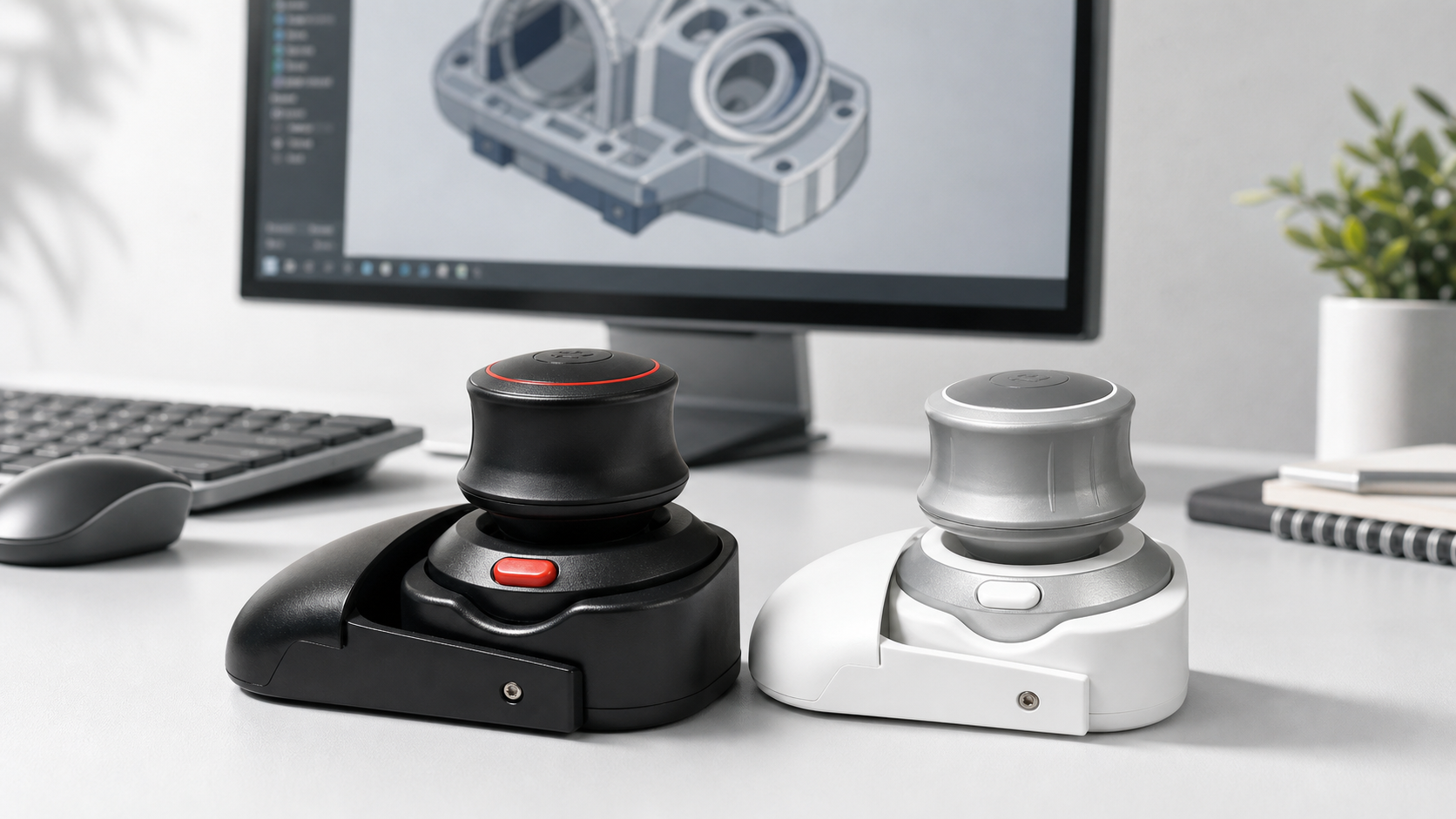
The Wireless 3D CAD Mouse fits the two-handed workflow as a compact navigation-side device. Because it is wireless, it can be placed where the non-dominant hand rests rather than where a cable allows.
That placement freedom matters on small desks, laptops, and shared workspaces. Pair it with a clean layout and conservative sensitivity settings before evaluating speed. If the desk is cramped, start with the small-workstation setup guide.
FAQ
Do both hands move at the same time?
Sometimes, but not constantly. The navigation hand makes small view corrections while the pointer hand selects, edits, or confirms actions.
Which hand should use the normal mouse?
Use your normal dominant-hand mouse setup unless you already work differently. Put the 3D mouse under the other hand for navigation.
Does this work for beginners?
Yes, but beginners should start slowly. Learn basic CAD commands first, then add the 3D mouse as a separate navigation habit.
Can two-handed workflow reduce fatigue?
It may reduce repeated scroll-and-drag patterns for some users, but comfort also depends on desk height, wrist angle, sensitivity, and break habits.
Workflow verdict
A two-handed CAD workflow is useful because it gives each hand a clear job. The regular mouse acts, the keyboard commands, and the 3D mouse moves the view. When that division matches your real work, model review can feel smoother and less interrupted.