
Blog
How to Navigate Large CAD Assemblies With a 3D Mouse
Jul
Large CAD assemblies are hard to navigate because the model contains too many possible centers of attention. A 3D mouse can help, but only if you use it with focus discipline. Smooth movement is useful when it brings you to the bracket, joint, clearance, or subassembly you need. It is not useful when it turns the whole assembly into a spinning object you cannot read.
The goal is controlled inspection. Move around the assembly in sections, use saved or standard views when needed, and keep the view centered on the design question you are trying to answer. Good assembly navigation feels more like reading a map than driving a camera.
Start with a subassembly, not the full model
When an assembly is dense, orbiting around the entire product often creates confusion. The view center may be far from the part you care about, so every rotation feels too wide. Instead, isolate or visually focus on the subassembly you are reviewing: hinge, motor mount, housing, bracket group, linkage, cable path, or fastener pattern.
Once the active area is smaller, a 3D mouse becomes more precise. You can orbit around the relevant feature instead of dragging the whole project around the screen. If your software supports selection-based rotation center, fit-to-selection, or isolate tools, learn them before raising 3D mouse speed.
Control zoom before orbit
In large models, zoom errors create most of the disorientation. If you zoom too far into a cluttered area, it becomes hard to tell which part you are seeing. If you zoom too far out, small clearance issues disappear. Use slow zoom, then orbit. Do not combine aggressive zoom and aggressive rotation until the target area is clear.
For precision work, settings matter. Lower sensitivity can feel slower at first, but it reduces overshoot and helps keep the model readable. The article on best 3D mouse settings for CAD navigation gives a practical baseline.
Use landmarks to avoid getting lost
Pick visual landmarks before navigating: the front face of the housing, the main shaft, a mounting plate, a connector, or a colored component. As you move, keep one landmark in mind. If the model begins to feel unfamiliar, stop and reset to a known view instead of continuing to drift.
Large assemblies reward slow movement. A dramatic orbit may look smooth, but it can hide important relationships. Use small view changes, inspect one relationship, then move to the next. This is especially important when reviewing supplier files or inherited assemblies where the model structure may not match your expectations.
Pair the 3D mouse with CAD visibility tools
A 3D mouse is not a substitute for hiding parts, sectioning, using transparency, suppressing components, or switching display modes. In fact, it works better when those tools are used well. Hide outer covers before inspecting an internal bracket. Use section views before checking interference. Switch to shaded-with-edges when edges matter.
Think of the 3D mouse as the movement layer. The CAD software still provides the visibility layer. When both are used together, assembly review becomes much more readable. For inspection patterns, see the mechanical part inspection workflow.
Set up the desk for long reviews
Large assembly review often takes longer than quick part editing. If your 3D mouse sits too far away, wrist and shoulder tension can build. Place it where the navigation hand can rest naturally. Keep the normal mouse free for selection and the keyboard close enough for hide, isolate, section, and measure shortcuts.
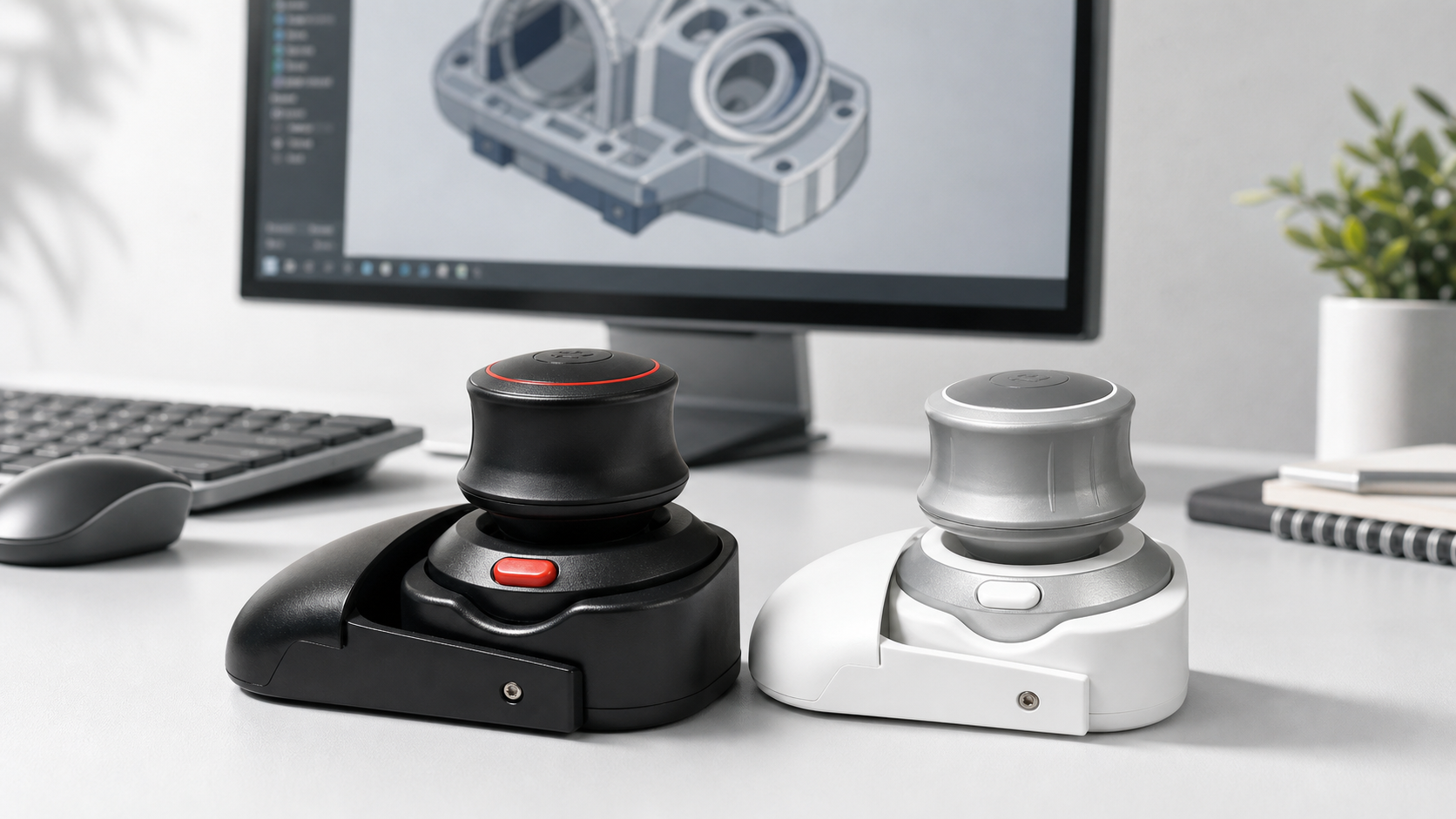
The Wireless 3D CAD Mouse fits assembly review best when compact placement matters. Because it is wireless, you can position it around your actual hand posture instead of routing the desk around a cable.
Assembly review checklist
- Choose the subassembly or feature before moving.
- Slow zoom down for dense areas.
- Use landmarks to keep orientation.
- Hide, isolate, section, or make parts transparent when needed.
- Reset to known views before continuing if you feel lost.
FAQ
Why do large assemblies feel harder than single parts?
The view center, visual clutter, and number of possible target features all increase. Small navigation errors are easier to lose inside a dense model.
Should I make the 3D mouse faster for assemblies?
Only slightly, and only after zoom feels controlled. Too much speed makes dense assemblies harder to inspect.
Can a 3D mouse fix slow assembly performance?
No. It can improve navigation control, but it will not solve graphics lag, heavy model structure, or an underpowered workstation.
What CAD tools should I use with it?
Use isolate, hide, transparency, section views, saved views, and fit-to-selection. These tools make 3D mouse movement more useful.
Assembly navigation takeaway
A 3D mouse helps large assemblies when you navigate with intent. Focus on subassemblies, slow the zoom, use visibility tools, and reset often. Smooth movement is valuable only when it keeps the design question easier to see.