
Blog
Using a 3D Mouse for Engineering Drawings and Model Review
Jul
A 3D mouse can help with engineering drawings when the drawing is tied to a 3D model that needs review. It will not dimension the drawing for you, and it will not replace drafting standards. Its value appears when reviewers need to move between the 2D sheet and the underlying model to understand whether the drawing communicates the design correctly.
Many drawing mistakes are really model-understanding mistakes. A hole pattern is hard to read because the part orientation is unclear. A section view misses the important internal feature. A note points to a surface that looks different in the model. Smooth 3D navigation can make those questions easier to resolve before release.
Use the model to explain the drawing
When reviewing a drawing, keep the 3D model available if possible. Use the drawing to see dimensions, tolerances, notes, and manufacturing intent. Use the model to understand shape, access, hidden features, and assembly context. The 3D mouse helps move through the model while the regular mouse handles sheet navigation, selection, and comments.
This is especially useful for parts with angled faces, internal features, mirrored details, or complex orientation. A static drawing view may not show why a dimension is confusing. A few slow rotations around the model can reveal whether the drawing needs a different view, section, detail, or note.
Check whether views match real inspection needs
Engineering drawings should make the important geometry easy to verify. During review, use the 3D model to ask whether the chosen front, top, side, section, and detail views support real inspection. If a machinist, supplier, teammate, or student will struggle to identify the feature, the drawing may need another view.
A 3D mouse is useful here because you can explore candidate angles quickly, then settle on the clearest orientation. The goal is not to replace standard views with random camera angles. It is to understand whether the standard views are enough. For part-level inspection, see the mechanical part inspection workflow.
Review model changes before updating sheets
Drawings often become risky after model changes. A boss moves, a hole gets larger, an edge receives a fillet, or an assembly clearance changes. Before updating or releasing the drawing, navigate around the changed areas in the model and confirm that the drawing still describes the important details.
This is not only a CAD operator task. Engineers, reviewers, students, and suppliers can all benefit from model review before signing off on a drawing. If the review involves external files, the article on reviewing supplier models with a 3D mouse is a useful companion.
Use slow movement during review meetings
In a meeting, fast navigation can make the model harder to follow. Move slowly, use saved views, and pause before explaining a feature. A 3D mouse can make the movement smoother, but the presenter still needs discipline. The best review motion is calm enough that everyone can track the geometry.
Plan a few views before the meeting: overall shape, critical section, mating area, tolerance-sensitive face, and final isometric. Use the 3D mouse to move between those points, not to improvise endlessly. For presentation-specific advice, read how to present a CAD model with a 3D mouse.
Where the Wireless 3D CAD Mouse fits
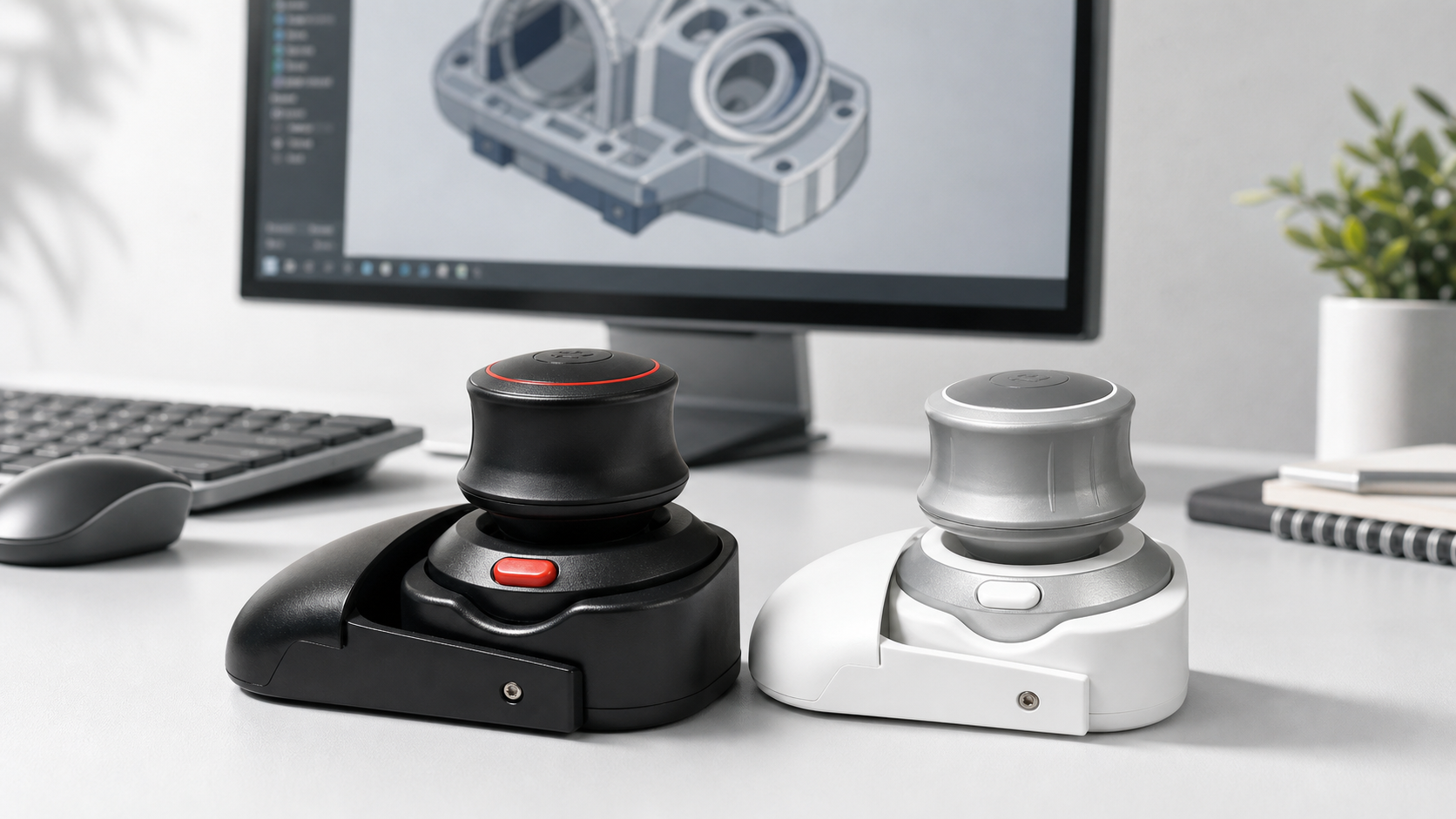
The Wireless 3D CAD Mouse fits drawing and model review as a compact navigation controller. It can sit beside a keyboard while the regular mouse remains available for comments, dimensions, and sheet interaction.
Because drawing review can involve long sessions, desk comfort matters. Keep sensitivity modest and place the device where the navigation hand can rest. A clean setup makes it easier to move between model, drawing, notes, and communication tools without breaking review focus.
Drawing review checklist
- Open the 3D model beside or behind the drawing.
- Use the model to confirm confusing views and hidden features.
- Check changed geometry before updating the drawing.
- Use saved views during meetings.
- Pause movement before explaining dimensions or notes.
FAQ
Does a 3D mouse help with 2D drawings?
It helps when the drawing is tied to a 3D model that needs review. It is less useful for purely 2D drafting.
Can it replace drawing standards?
No. Drawing standards, dimensioning practice, tolerances, and clear notes still matter. The 3D mouse only helps review the model context.
Is it useful in design review meetings?
Yes, if movement is slow and planned. Smooth navigation can help reviewers understand features, but fast spinning can distract the group.
Should reviewers use saved views too?
Yes. Saved views give structure. The 3D mouse is best used to move smoothly between planned review points.
Review takeaway
A 3D mouse helps engineering drawing review by connecting the sheet to the model behind it. Use it to inspect geometry, test view choices, communicate changes, and make meetings easier to follow. It supports review judgment; it does not replace it.