
Blog
CAD Viewport Navigation Mistakes Beginners Make
Jul
CAD viewport navigation mistakes are easy to dismiss as beginner clumsiness, but they can slow real design work. Losing the model, rotating around the wrong center, zooming too far, fighting inverted controls, and moving too quickly all interrupt the part of CAD that actually matters: understanding and editing the design.
A 3D mouse can help with navigation, but it does not automatically fix poor habits. Beginners still need slow movement, clear view centers, practical settings, and a habit of resetting before the model becomes unreadable. The real improvement comes from making each view change intentional instead of reacting after the model is already lost.
Mistake 1: moving before choosing a target
Many beginners start rotating as soon as the model appears. They move the view without deciding what they need to inspect. This creates random motion and makes the model feel harder than it is. Before navigating, choose a target: a hole, edge, face, clearance, sketch, section, or assembly relationship.
Once the target is clear, the movement becomes smaller. You are not “looking around.” You are positioning the model so a specific design question can be answered. This habit matters whether you use a normal mouse, trackpad, or 3D mouse. It also makes practice easier because success becomes visible.
Mistake 2: over-zooming into dense geometry
Zooming too far into a model can make the screen meaningless. You may see a face, but not know which face. In assemblies, over-zooming can bury you inside parts or make it hard to recover. Beginners then pan, rotate, and zoom again until orientation is lost.
Use zoom in stages. Move closer, pause, confirm the landmark, then move closer again. If you use a 3D mouse, lower zoom sensitivity until you can approach a feature without overshooting. The settings guide for smooth CAD navigation explains how to tune this.
Mistake 3: rotating around the wrong center
If the rotation center is far from the feature you care about, every orbit feels wide and unpredictable. This happens often in large assemblies or imported models. The user tries to inspect a small part, but the view swings around the entire assembly.
Use fit-to-selection, set rotation center, isolate, or saved views when your software supports them. If not, reframe the model manually before orbiting. The goal is to make the feature of interest feel like the center of the review, not a tiny object flying around the edge of the screen.
Mistake 4: confusing speed with control
Fast viewport movement looks confident, but it often hides poor control. Beginners may spin the model quickly, then spend extra time recovering. In real CAD work, small and accurate movement is more useful than dramatic motion.
With a 3D mouse, this means gentle pressure and modest sensitivity. With a regular mouse, it means shorter drags and more frequent view resets. A slow view that keeps the feature visible is better than a fast view that loses the design context.
Mistake 5: using the wrong device for every job
The regular mouse should not do everything forever, but a 3D mouse should not do everything either. Beginners sometimes try to turn a 3D mouse into a command center before learning basic movement. Others refuse to use keyboard shortcuts and force the normal mouse through every navigation and command step.
A cleaner setup separates roles: regular mouse for selection, keyboard for commands, and 3D mouse for view movement. The two-handed CAD workflow shows how that separation can reduce interruptions.
How the Wireless 3D CAD Mouse fits better habits
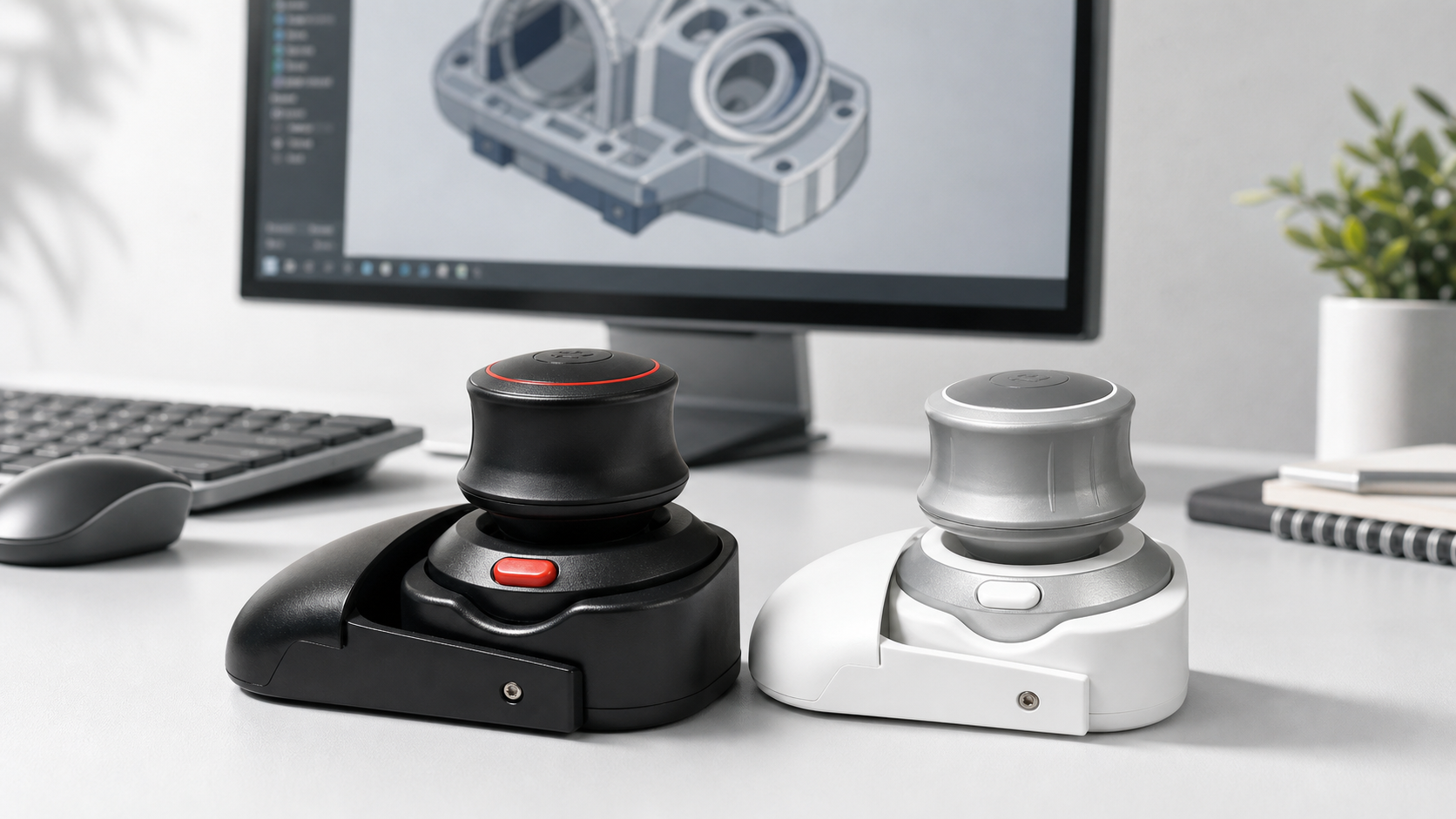
The Wireless 3D CAD Mouse is most helpful when used to build controlled navigation habits. Place it comfortably, slow it down, and practice on known parts before using it during a deadline.
If you are new, follow a short test rather than guessing. The 30-minute new 3D mouse test gives enough structure to spot speed, direction, and placement problems early.
FAQ
Why do I keep losing the model?
You may be zooming too fast, rotating around the wrong center, or moving without a target. Reset the view and restart with slower movement.
Should I use fit view often?
Yes. Fit view, standard views, and saved views are recovery tools. Using them is not a failure; it keeps navigation structured.
Can a 3D mouse fix bad navigation habits?
It can help, but only if settings and practice are disciplined. High sensitivity and random movement will still cause problems.
What should beginners practice first?
Practice centering one feature, zooming toward it slowly, orbiting slightly, and returning to a known view. Repeat with simple parts.
Navigation takeaway
Most CAD viewport mistakes come from moving too much, too fast, or without a clear target. Slow down, choose the feature first, control zoom, set the view center, and keep device roles simple. Better navigation makes every later CAD task easier.