
Blog
3D Mouse Workflow for Product Designers
Jul
Product designers use 3D views for more than technical inspection. They evaluate proportion, silhouette, surface transitions, parting lines, user touch points, visual balance, and how a design will be presented to clients or teammates. A 3D mouse can help when those decisions require constant viewpoint changes.
The best workflow is not nonstop rotation. It is a structured loop: explore the form, pause at meaningful angles, inspect details, compare alternatives, and prepare views for feedback. A 3D mouse supports that loop by making the movement between views smoother. That is valuable because product design judgment often happens in the transition between angles, where a curve, seam, or handle suddenly reads differently.
Use broad orbiting during concept review
During early concept work, product designers often need to judge the whole shape rather than one dimension. Slow orbiting helps reveal whether the object feels balanced from front, side, rear, and three-quarter views. It can also expose awkward transitions that look fine from a single camera angle.
Keep the movement slow enough to notice the form. A fast spin may hide the very problem you are trying to see. Stop at key angles and ask specific questions: Does the handle read clearly? Does the top surface feel too heavy? Does the product look stable from the side? Does the silhouette match the intended use? Those pauses turn navigation into critique instead of motion.
Switch to detail inspection when the concept settles
Once the broad form is promising, use the 3D mouse for closer inspection. Check button placement, seam lines, mounting points, cable exits, texture breaks, display openings, vents, and assembly features. The regular mouse can select faces or measurements while the 3D mouse positions the model.
This is where product design overlaps with mechanical review. The shape must look right, but it also has to be buildable. For a more engineering-focused inspection path, read the mechanical part inspection workflow.
Compare alternatives from the same views
Design alternatives are easier to judge when they are shown from consistent angles. Use saved views or repeatable positions before comparing versions. A 3D mouse can help you reach those positions smoothly, but the comparison still needs structure.
For example, compare three enclosure concepts from front, top, side, hand-use angle, and exploded or section view. If one version only looks good from a dramatic perspective, that may be a presentation trick rather than a better design. Repeatable view discipline keeps the review honest.
Prepare presentation movement early
Product designers often need to show the design to people who are not inside the CAD file every day. Smooth movement matters in that context. A slow orbit around the product, a gentle zoom into a user touch point, or a clean transition to an internal feature can make feedback easier.
Plan the movement before the meeting. Decide which views tell the story: overall form, main user interaction, assembly feature, scale cue, and final hero angle. For presentation technique, see how to present a CAD model with a 3D mouse.
Keep the desk setup light
Product designers may work with sketchbooks, tablets, reference images, keyboards, and normal mice at the same desk. A 3D mouse should not crowd the creative workspace. Keep it reachable but not central. The device is there to support form review, not dominate the setup.
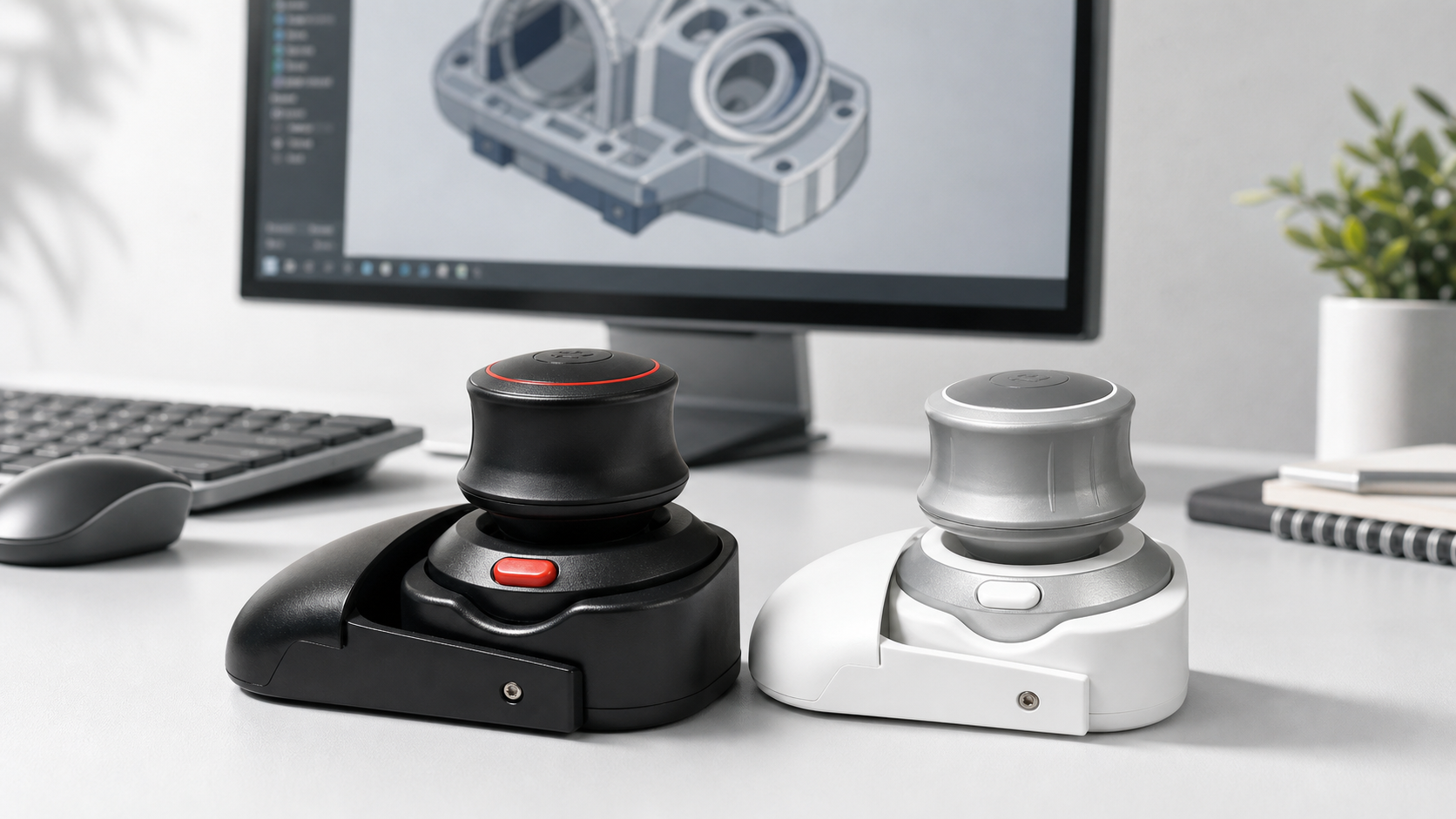
The Wireless 3D CAD Mouse can fit product design desks where a compact navigation controller is easier to place than a large wired accessory. Use it with modest speed and familiar projects before judging whether it belongs in your daily design routine. The best test is a design you already know well enough to notice smoother form review.
Workflow checklist for product designers
- Start with broad form review before detail inspection.
- Pause at meaningful angles instead of spinning continuously.
- Use saved views for comparing design alternatives.
- Inspect seams, openings, touch points, and assembly features.
- Plan presentation movement before design reviews.
FAQ
Is a 3D mouse useful for industrial design?
Yes, when the work involves frequent 3D form review, surface evaluation, model presentation, or detailed product geometry inspection.
Does it help with sketching?
Not directly. It helps with navigating 3D models. Sketching, selection, and drawing still depend on the regular mouse, tablet, or pen workflow.
Should product designers use saved views?
Yes. Saved views make design comparisons more objective and help presentations stay organized.
Can it help client feedback sessions?
It can, if movement is slow and planned. Smooth navigation helps clients understand the model, but uncontrolled motion can distract them.
Product design takeaway
A 3D mouse supports product designers when form, detail, comparison, and presentation all require controlled viewpoint changes. Use it to move deliberately through design questions, not to create motion for its own sake. If the movement helps you see a better design decision in practice, it has earned its place.