Blog
3D Mouse Workflow for Engineers Reviewing Supplier Models
Jul
Reviewing supplier models is different from reviewing your own CAD work. You may not know how the file was built, what assumptions were made, whether the units are correct, or whether the model contains hidden simplifications. A 3D mouse can make the visual review smoother, but the process still needs a checklist.
The aim is to understand the incoming file before trusting it. Inspect orientation, scale, missing details, mating faces, hole patterns, clearances, naming, and any feature that affects manufacturing, assembly, or quoting. Treat the first review as a risk scan, not a sign-off.
Start with file context before navigation
Before moving around the model, confirm the basics. What file type arrived: STEP, IGES, Parasolid, native CAD, mesh, or drawing export? What units should it use? Is it a reference model, production model, quotation model, or concept file? Does it represent one part, one subassembly, or a simplified envelope?
These questions shape the review. If the file is only a packaging envelope, missing internal features may be normal. If it is meant for manufacturing, those gaps may be serious. Navigation helps you see the model, but context tells you what the model is supposed to prove. Without that context, smooth movement can make an incomplete file look more trustworthy than it is.
Make an orientation pass
Use the 3D mouse to make a slow orientation pass around the model. Identify front, top, mounting direction, key faces, connection points, and any obvious asymmetry. Do this before zooming into details. If you start too close, you may miss that the whole model is flipped, scaled incorrectly, or missing a major component.
Large supplier assemblies should be reviewed in sections. Focus on one subassembly, then move to the next. The article on navigating large CAD assemblies has useful tactics for staying oriented.
Inspect interfaces and risk areas
Supplier models matter most at the interfaces. Check mounting holes, connectors, gasket faces, bearing seats, fastener access, keep-out zones, cable exits, and clearance around moving parts. Use section views or transparency if the important geometry is hidden.
A 3D mouse helps because you can move around these areas slowly while selecting or measuring with the regular mouse. If a clearance looks questionable, capture the view and record the question. For a part-level checklist, see the mechanical part inspection workflow.
Capture evidence for supplier questions
Supplier review should produce clear feedback. Screenshots, saved views, marked-up drawings, and short notes are better than vague messages like “please check this area.” Use the 3D mouse to position the model, then capture the exact view that shows the concern. Include orientation and scale context so the supplier can reproduce the issue quickly.
Slow movement also helps during calls. If you are screen-sharing, avoid fast spins. Move from the full model to the issue area, pause, explain the concern, then show the alternate angle. That makes communication easier for people who did not build the file.
Do not skip technical validation
Visual review is not enough. Check units, mass properties, missing bodies, broken surfaces, imported geometry warnings, interference, tolerances, and drawing references when relevant. A 3D mouse helps you inspect, but CAD analysis tools provide proof.
If the model will feed manufacturing or rapid prototyping, review export settings and downstream requirements too. The rapid prototyping review workflow is a useful next step when supplier geometry is headed toward a physical part.
Where the Wireless 3D CAD Mouse fits
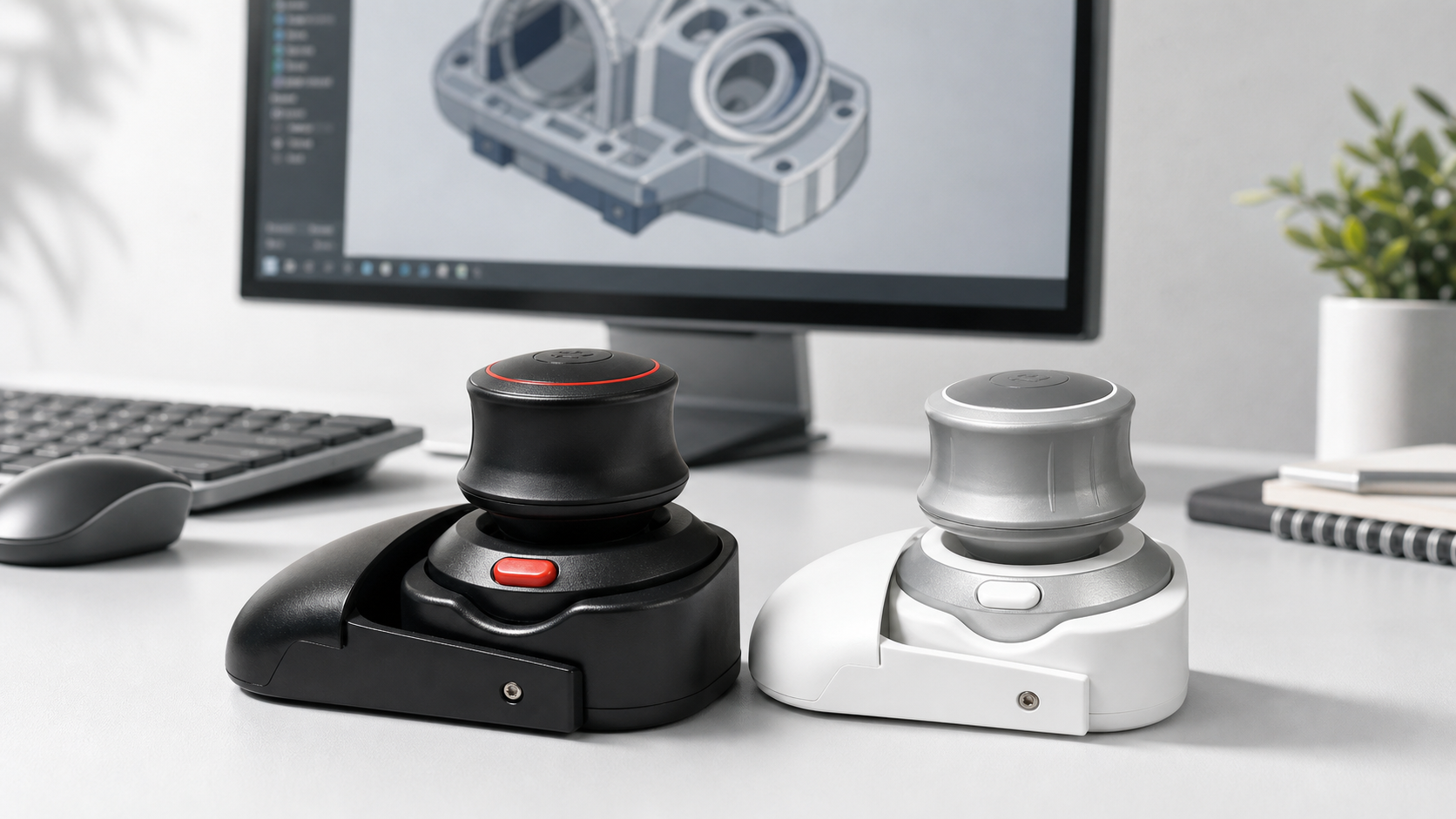
The Wireless 3D CAD Mouse is useful for supplier review when you need compact, controlled navigation at a review desk. It lets one hand position the model while the other selects, measures, screenshots, or comments.
That said, it should support a disciplined review process. If the file is risky, do not let smooth navigation create false confidence. Keep a checklist and document the concerns. A clean orbit is useful only after the file’s purpose, source, and required accuracy are understood.
FAQ
Can a 3D mouse verify a supplier model?
No. It helps with visual inspection. Verification still requires measurements, file checks, interference review, drawings, and engineering judgment.
What should I check first in an incoming STEP file?
Check units, orientation, missing bodies, major interfaces, and whether the file represents the level of detail you expected.
Is smooth navigation useful during supplier calls?
Yes, if you move slowly and pause at issue areas. Controlled movement makes screen-sharing easier to follow.
Should I capture screenshots during review?
Yes. Screenshots or saved views turn vague comments into clear supplier questions and reduce back-and-forth.
Supplier review takeaway
A 3D mouse can make supplier model review easier to see and explain, but it should be paired with context checks, interface inspection, technical validation, and clear evidence capture. Smooth movement is helpful only when it leads to better questions, cleaner feedback, and fewer assumptions about the incoming file.