Blog
Blender Viewport Navigation Tips for 3D Mouse Users
Jul
Good Blender viewport navigation is not about moving faster all the time. It is about moving at the right speed for the job. A 3D mouse can make the viewport feel smoother, but only if you build a little discipline around speed, focal point, and practice scenes.
For many users, the biggest gain is separating navigation from editing. The normal mouse keeps selecting objects, edges, faces, and tools. The other hand handles orbit, pan, zoom, or scene movement. That rhythm is close to the two-handed workflow CAD users rely on, but the same idea can apply to Blender modeling and layout.
Use slow movement for mesh editing
When editing mesh details, fast viewport motion is usually a problem. If you are adjusting bevels, checking a loop cut, or selecting small faces, lower the navigation speed. Slow orbiting lets you keep the selected area in view without overshooting the model.
A useful habit is to stop navigating before you select. Move around the mesh, pause, select or edit with the normal mouse, then continue. Trying to move and select at the same time can feel impressive, but it often leads to misclicks and lost focus.
Use faster movement for scene layout
Scene layout is different. When arranging furniture, blocking an environment, checking camera views, or moving between grouped objects, faster movement can save time. You are not selecting tiny vertices. You are judging scale, spacing, and composition.
Set one comfortable navigation speed for detailed work and another for large scenes if your device software allows it. If not, choose a middle setting that does not feel twitchy. Smooth control matters more than maximum speed.
Keep a clear focal point
One common mistake is orbiting around the wrong part of the scene. Before you move, decide what you are inspecting: a selected object, a room corner, a character face, a product detail, or a camera target. If the view starts drifting away, reset around the selected object or use Blender’s native view controls to recover.
This is especially important in dense scenes. Without a clear focal point, a 3D mouse can make you feel lost faster. With a clear focal point, it becomes a precise inspection tool.
Practice scenes that teach control
Use three simple files for practice. First, a cube with bevels and small details for close orbiting. Second, a room or desk scene for pan and zoom discipline. Third, a larger environment for fly-through movement and camera planning.
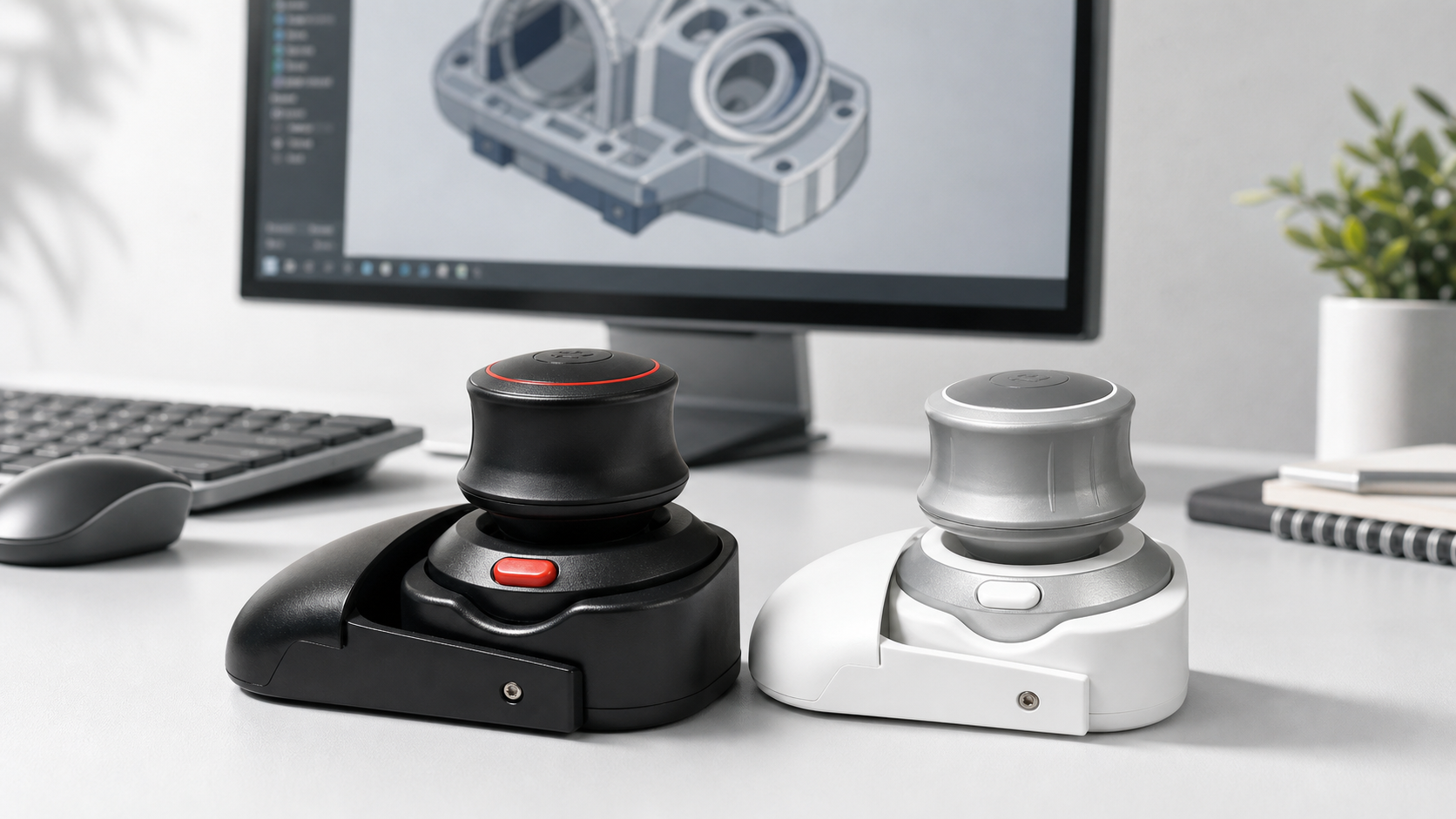
The Wireless 3D CAD Mouse fits this kind of compact Blender desk setup because it adds wireless spatial navigation without replacing your main mouse. It is a general Bluetooth 3D CAD mouse controller, so you should still verify behavior with your Blender version, driver setup, and operating system.
FAQ
Why does my viewport feel too fast?
Your sensitivity may be too high for the scale of the model. Lower speed for mesh editing and reserve faster movement for scene layout.
Should I navigate while selecting?
Usually no. Move, pause, select, then move again. That habit keeps edits cleaner.
What Blender scenes are best for practice?
Use a detailed object, an interior scene, and a larger environment. Each teaches a different navigation speed.
Do I still need Blender view shortcuts?
Yes. View shortcuts, frame selected, camera view, and local view remain useful recovery tools.
Bottom line
Blender 3D mouse navigation works best when it is controlled, not flashy. Tune speed for the task, orbit around a clear target, and practice on real scenes before deciding how it fits your workflow.