
Blog
3D Mouse for Rhino: Smooth Surface Modeling Navigation
Jul
Rhino users often work in a space where form, surface quality, and model readability matter. Industrial design, architecture, jewelry, product concepts, and detailed NURBS modeling all depend on judging shape from many angles. A 3D mouse can support that kind of review by making orbit, pan, and zoom feel more continuous. If you are still comparing device roles, start with the practical 3D mouse vs regular mouse for CAD distinction.
The benefit is strongest when you already spend long sessions checking surfaces and proportions. If your Rhino work is occasional or mostly 2D drafting, the value may be limited. If you constantly rotate around products, buildings, or curved forms, dedicated navigation can make the workspace feel more fluid.
Smooth orbiting and surface continuity
Surface modeling rewards slow inspection. A curve, blend, fillet, or transition can look fine from one view and feel wrong from another. Smooth orbiting lets you study highlights, silhouette, and continuity without jumping between fixed views every few seconds.
This does not replace Rhino analysis tools, rendered previews, or modeling judgment. It simply helps you look at the model with less friction. That can be valuable when refining a handle, enclosure, furniture piece, vehicle surface, or architectural detail.
Product design and architecture workflows
For product designers, a 3D mouse is useful during form review, part comparison, ergonomic checks, and presentation. You can move around the object while keeping the regular mouse free for selection and tool use. For architecture models, it helps with massing, interior spaces, facade studies, and client walkthrough preparation.
The same idea applies when reviewing imported geometry. If you receive files from another tool, smooth navigation can make it easier to understand where the model is clean, where it is heavy, and where it needs repair.
Adjust speed for precision curves
Rhino users should be careful with speed. Fast movement can hide surface problems. Lower sensitivity when reviewing small curves, jewelry-scale details, tight blends, or precise intersections. Use broader movement only when inspecting large models or moving between areas.
Pause before selecting. If you try to navigate and select tiny curve or surface elements at the same time, you may lose accuracy. Move the view first, stop, then edit.
A compact Rhino desk setup
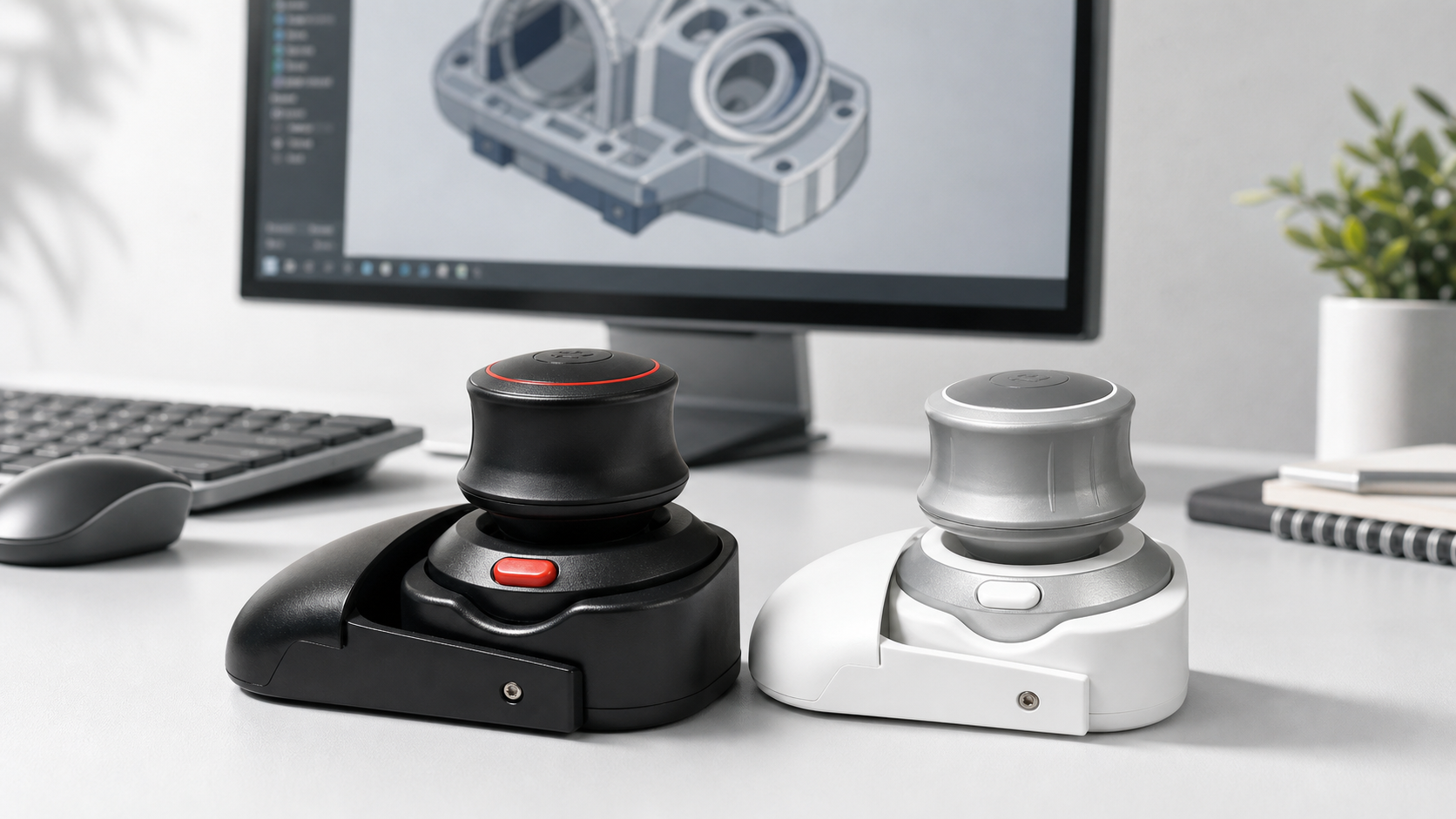
The Wireless 3D CAD Mouse can fit into a Rhino desk setup as a compact Bluetooth navigation controller. It is designed for general CAD, 3D modeling, Blender workflows, engineering drawings, VR scene navigation, and Google Earth style movement, so Rhino users should verify behavior in their operating system and software version before relying on it professionally.
If you are comparing options, also think about your whole workstation: normal mouse, keyboard shortcuts, tablet or pen if used, and how much desk space you have for a second controller.
FAQ
Is a 3D mouse useful for Rhino surface modeling?
It can be useful because surface review often requires slow orbiting around curves, transitions, and silhouettes.
Will it replace Rhino analysis tools?
No. It supports visual inspection, but analysis tools and modeling judgment still matter.
What speed should I use?
Use slower movement for small curves and precise surfaces, and faster movement only for large model navigation.
Who benefits most?
Product designers, industrial designers, architects, jewelry modelers, and anyone who reviews 3D form for long sessions.
Bottom line
A 3D mouse for Rhino is most useful when smooth spatial review is part of the design process. Use it to study form calmly, keep selection precise, and verify the device with your actual Rhino setup.