Blog
3D Mouse for 3D Printing Design Checks
Jul
3D printing rewards careful inspection before export. A model that looks fine from one angle can still have weak walls, hidden intersections, unsupported overhangs, awkward orientation, or details that will not print cleanly. A 3D mouse can help during design checks because it makes model review more continuous.
It will not fix a bad mesh, replace slicer judgment, or guarantee a successful print. Its role is navigation: moving around the object, inspecting problem areas, and making it easier to see what deserves attention before printing.
Check overhangs, walls, and hidden geometry
Overhangs are easier to understand when you rotate around the part slowly. Instead of looking at one fixed view, inspect the underside, corners, holes, bridges, and decorative details. If a feature depends on support material, decide whether the print orientation still makes sense.
Wall thickness also benefits from careful review. Thin details, small tabs, snap features, and embossed text may look acceptable on screen but fail in the real print. Move around the model and check whether small features are actually printable at the chosen scale.
Review slicer previews more carefully
The slicer preview deserves attention. Layer view, support preview, infill, perimeter paths, and travel moves can reveal problems before the printer wastes filament. A 3D mouse can help you move through the preview calmly, especially on complex parts.
This is similar to the broader habit of model review before rapid prototyping, but the slicer adds print-specific truth. Trust the preview when it reveals missing walls, strange islands, or support-heavy areas.
Pre-export inspection checklist
Before export, check scale, wall thickness, hole clearance, overhangs, orientation, hidden geometry, non-manifold areas, text size, and moving part gaps. Then check the slicer preview for supports, layer paths, and print time. This process matters more than speed.
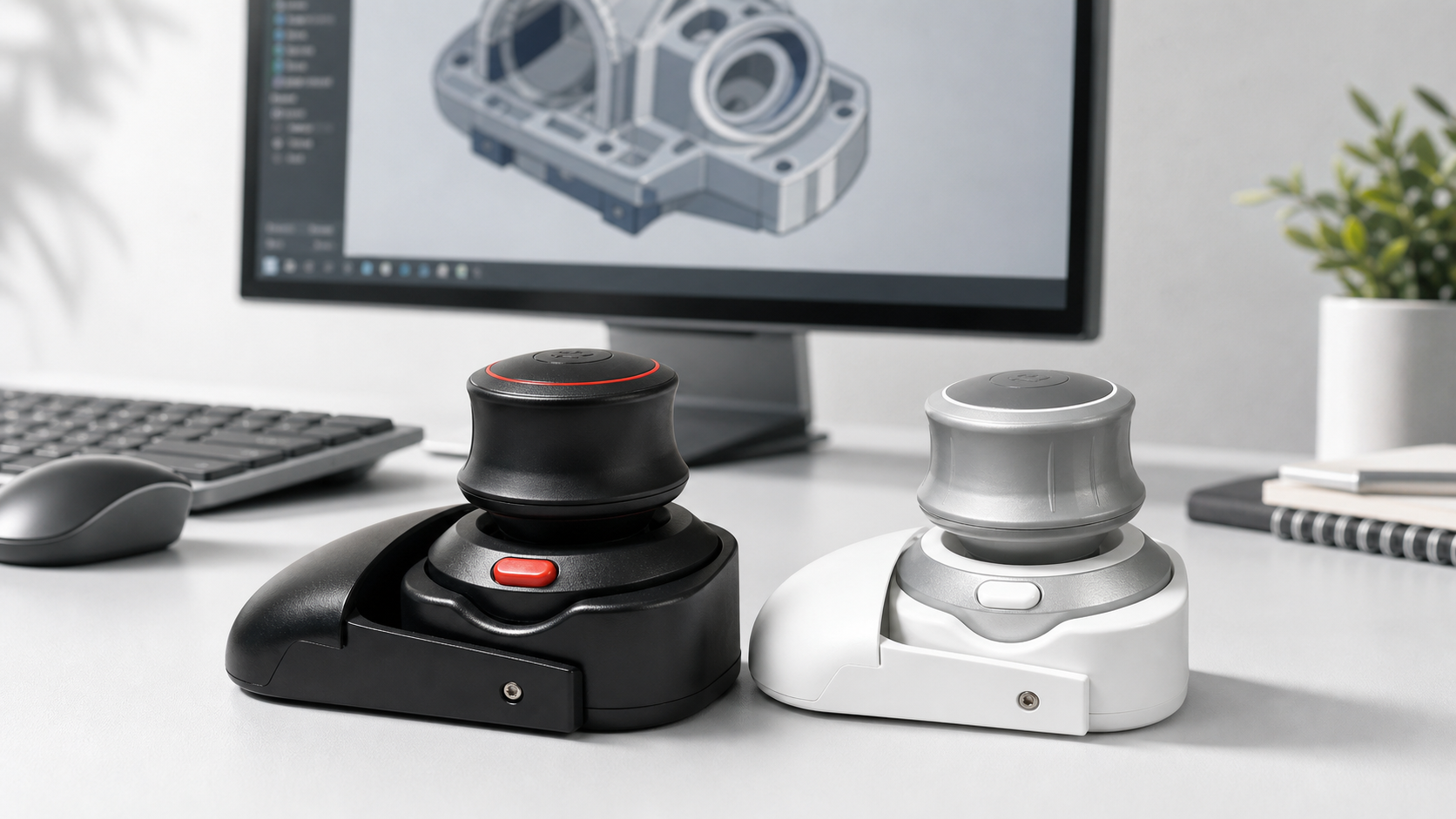
The Wireless 3D CAD Mouse can act as a navigation helper during these checks. It is most useful when you already inspect models often in CAD, Blender, slicers, or 3D modeling software.
When it is worth using
For simple calibration cubes, it is not necessary. For detailed parts, product prototypes, miniatures, enclosures, mechanical brackets, or multi-part prints, smoother navigation can reduce missed details. It is a small tool for a careful workflow.
It is also useful when a print has already failed once. Open the design again, review the failed area from several angles, then compare that view with the slicer preview. The extra inspection step can turn a vague failure into a specific fix.
FAQ
Can a 3D mouse fix bad STL files?
No. It helps you inspect the file, but repair still requires modeling, mesh repair, or slicer tools.
What print issues should I inspect?
Look for overhangs, weak walls, tiny details, hidden intersections, hole clearance, and support-heavy areas.
Is slicer preview still necessary?
Yes. The slicer preview shows layer behavior that a normal model view may not reveal.
Who benefits most?
Makers, prototype builders, product designers, and anyone checking detailed prints before wasting material.
Bottom line
A 3D mouse for 3D printing is a review aid. It helps you inspect the model and slicer preview more carefully before committing to a print.