
Blog
Best CAD Mouse Setup Under $150
Jul
A CAD mouse setup under $150 has to be realistic. You cannot buy every premium accessory, so the goal is to spend where the workflow actually improves: comfort, selection accuracy, keyboard shortcuts, and 3D navigation if model review is part of the work.
For many budget users, the best setup is not one expensive mouse. It is a balanced stack: a reliable normal mouse, a keyboard layout you know, and a dedicated navigation controller only if 3D movement is a daily problem.
A realistic budget accessory stack
Start with the basics. A comfortable normal mouse handles selection, menus, sketches, browser tabs, and general computer work. A familiar keyboard handles shortcuts, command entry, dimensions, and view recovery. Those two tools remain essential even when a 3D mouse is added.
If the budget allows and the workflow justifies it, add a compact 3D navigation controller. This is most useful for CAD users who inspect parts, assemblies, scenes, or models frequently. It is less useful for mostly 2D drafting.
Where to spend the money
Do not spend the entire budget on a device that solves the wrong problem. If your hand hurts, prioritize ergonomics. If selection is imprecise, choose a better normal mouse. If commands slow you down, improve shortcuts. If orbiting, panning, and zooming interrupt you all day, consider 3D navigation.
A 3D mouse and regular mouse do different jobs, so a good budget setup should not pretend one replaces the other.
Where the $129 controller fits
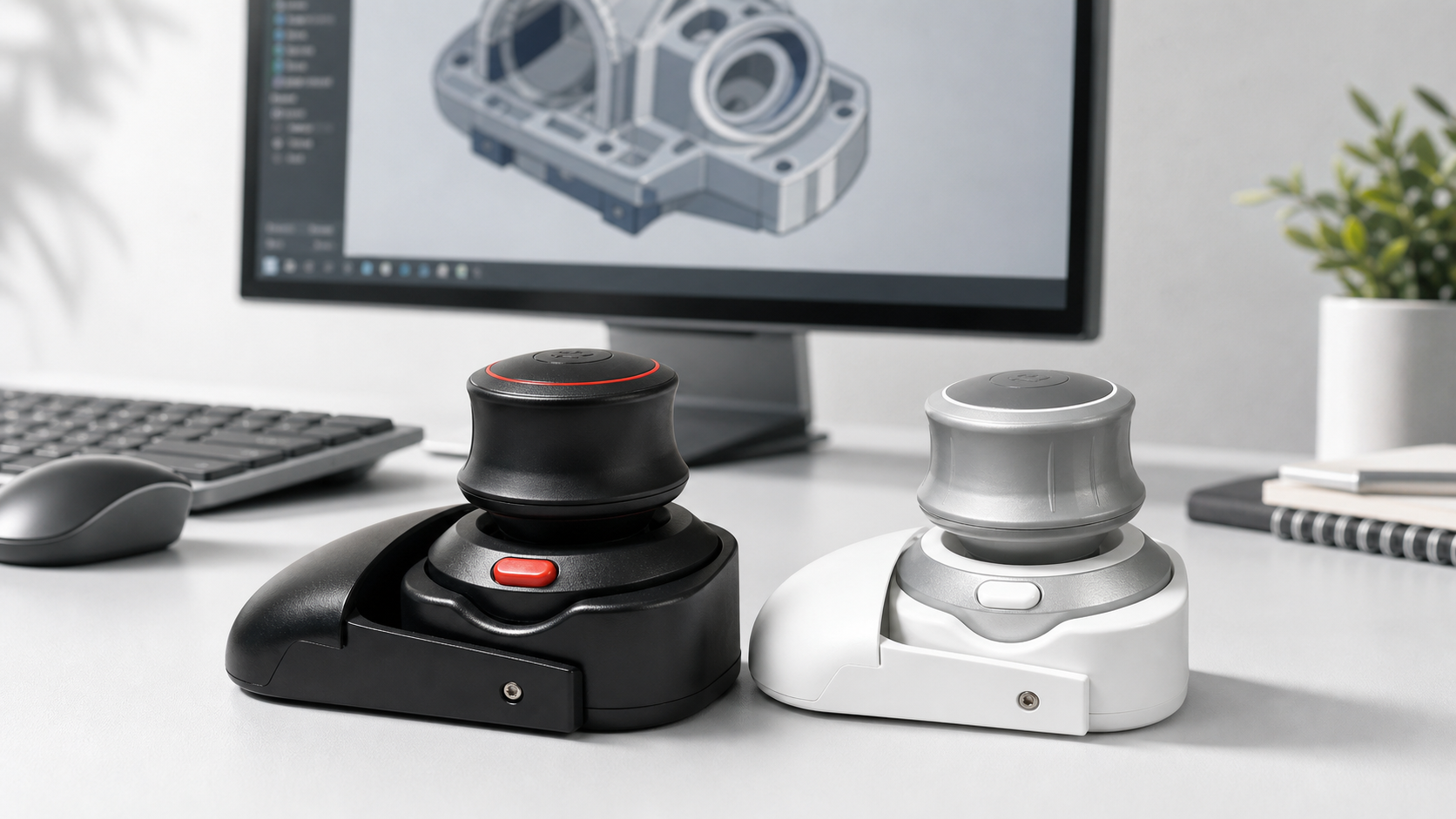
The Wireless 3D CAD Mouse is the main 3D navigation item to consider in this under-$150 setup. At $129, it leaves a little room for small accessories while giving users a dedicated Bluetooth controller for CAD, 3D modeling, Blender workflows, VR scene navigation, and Google Earth style movement.
What it can solve: repeated spatial navigation, model review friction, and a crowded desk that benefits from wireless control. What it cannot solve: weak CAD fundamentals, poor model organization, lack of shortcuts, or software compatibility problems. Test those before treating any purchase as final.
Who should use this setup
Students, hobby CAD users, makers, freelance designers, and small engineering teams can all benefit from a practical setup if their work includes real 3D review. Users who rarely open 3D models should keep the budget simple.
The best sign is repetition. If you review models every week, a navigation item earns its place. If you only need it once a month, keep the setup lean.
FAQ
Can I build a useful CAD setup under $150?
Yes, if you focus on actual workflow needs instead of buying every accessory.
Should I buy a 3D mouse first?
Only if navigation is the bottleneck. Otherwise improve mouse comfort, shortcuts, and CAD basics first.
What does a $129 controller solve?
It can help with repeated 3D navigation and model review, but it will not replace skill or compatibility checks.
Is this setup enough for professionals?
It can be enough for some users, but heavy daily CAD teams may still prefer premium ecosystems and standardized tools.
Bottom line
The best CAD mouse setup under $150 is practical and honest. Spend on navigation only when navigation is the repeated problem.