
Blog
3D Mouse for Mechanical Engineers: Practical Use Cases
Jul
Mechanical engineers spend a lot of time moving around parts that are not flat: housings, brackets, fixtures, shafts, assemblies, supplier models, and drawings tied back to 3D geometry. A 3D mouse can help when that movement is repeated enough to become a daily friction point.
The value is not magic speed. It is smoother inspection. When one hand controls the view and the other keeps the regular mouse ready for selection, model review can feel less interrupted.
Assembly review is the strongest use case
Large assemblies are where mechanical engineers often notice the difference first. You may need to orbit around a fastener pattern, look behind a bracket, zoom into a clearance issue, then return to a top-level view for discussion.
A 3D mouse gives that navigation a dedicated control. It can make design reviews easier to follow because the view changes continuously instead of jumping through awkward mouse drags and keyboard shortcuts.
Part inspection benefits from slower control
For individual parts, the important feature is not speed. It is controlled movement around small geometry. Fillets, bosses, holes, ribs, wall thickness, and undercuts all become easier to inspect when the view can move in small steps.
If your controller feels too fast for detail work, tune it before judging the workflow. The guide on 3D mouse sensitivity settings for precision modeling is a useful starting point.
Supplier models and drawing checks
Mechanical teams often receive STEP files, enclosure models, tooling concepts, and supplier revisions. A 3D mouse can help you inspect those files without losing the context of the full assembly. It is especially useful when you need to explain the issue to someone else on a call.
Drawing review can also benefit when the drawing references a model that needs quick orientation. The controller does not replace dimensions, tolerances, or engineering judgment. It simply makes the spatial part of review easier to manage.
When it may not matter
If your work is mostly 2D drawings, spreadsheet review, documentation, or occasional model viewing, a 3D mouse may not be the next best purchase. It earns its place when 3D inspection happens often.
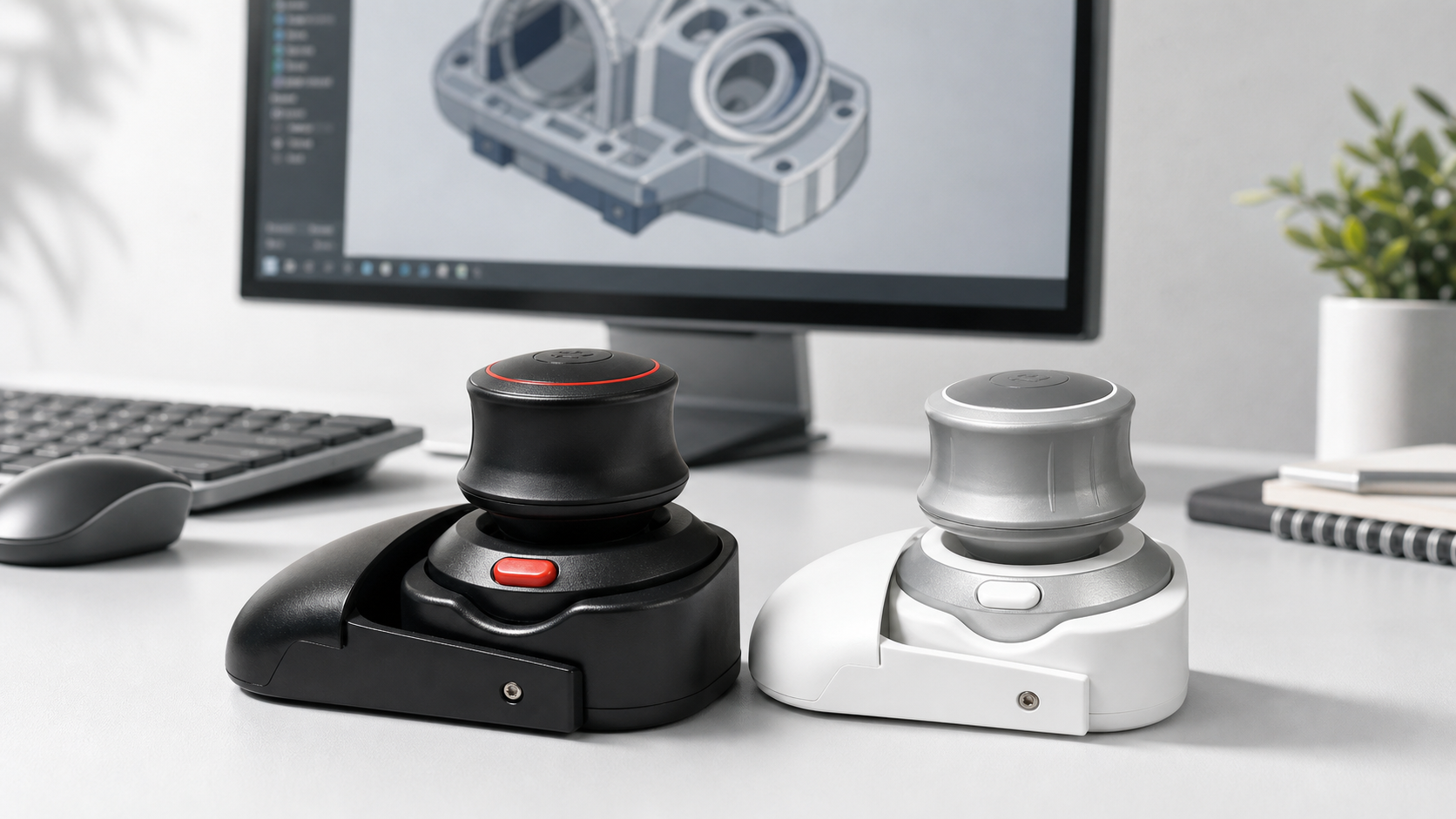
The Wireless 3D CAD Mouse is worth testing if your engineering work includes repeated CAD navigation, assembly inspection, supplier model review, or presentation-style walkthroughs. Test it in your actual CAD tool before standardizing it.
FAQ
Do mechanical engineers need a 3D mouse?
Not all of them. It is most useful for engineers who inspect and present 3D models frequently.
Does it replace a normal mouse?
No. The normal mouse still handles selection, dimensions, menus, and many editing actions.
Is it useful for supplier STEP files?
Yes, if your software supports the controller and you review imported models often.
Should a team buy one for every engineer?
Pilot one or two devices first, then decide based on real review and modeling use.
Bottom line
A 3D mouse fits mechanical engineering when 3D model movement is a repeated part of the job. It helps most in assembly review, part inspection, and supplier-model discussion. For mostly 2D work, it is optional rather than essential.