
Blog
3D Mouse for Industrial Designers: Better Form Exploration
Jul
Industrial designers judge shape from many angles. A product that looks balanced from the front can feel heavy from the side, awkward from above, or unresolved around a seam. A 3D mouse can support that kind of form exploration because it makes viewpoint changes feel more fluid.
The device is not a design shortcut. It will not make a weak concept good. Its value is in helping you inspect proportion, surface flow, enclosure details, and presentation views without constantly interrupting the creative rhythm.
Form exploration needs continuous movement
During early form work, designers often rotate the model again and again. You look for silhouette, stance, thickness, corner softness, and how surfaces catch light. Continuous navigation helps because the object can be judged as a whole instead of as disconnected snapshots.
This is especially useful for handheld products, electronics enclosures, desk accessories, small appliances, and tools where proportion changes are subtle. A smooth orbit can reveal whether a curve feels intentional or accidental.
Surface and enclosure checks
Industrial design review often sits between aesthetics and engineering. You may need to inspect part lines, button placement, vents, charging ports, labels, and manufacturing constraints. A 3D mouse can make those checks less clumsy when you are moving from one side of the product to another.
For small features, lower sensitivity matters. If the controller is tuned only for broad movement, it may feel too quick around detailed surfaces.
Concept review and presentation flow
When showing a concept to a teammate or client, view movement should be readable. Sudden spins make people lose orientation. A controller can help you guide attention from the front view to the side profile, then to a detail and back to the whole product.
This is close to the method in presenting a CAD model with a 3D mouse: plan the movement before the meeting, then keep it calm.
Small product examples
For an enclosure, use the controller to compare wall thickness, seam placement, button reach, and port visibility. For a handheld device, orbit around grip surfaces and inspect how the product sits in the hand. For a desk product, test top-down and seated-user viewing angles.
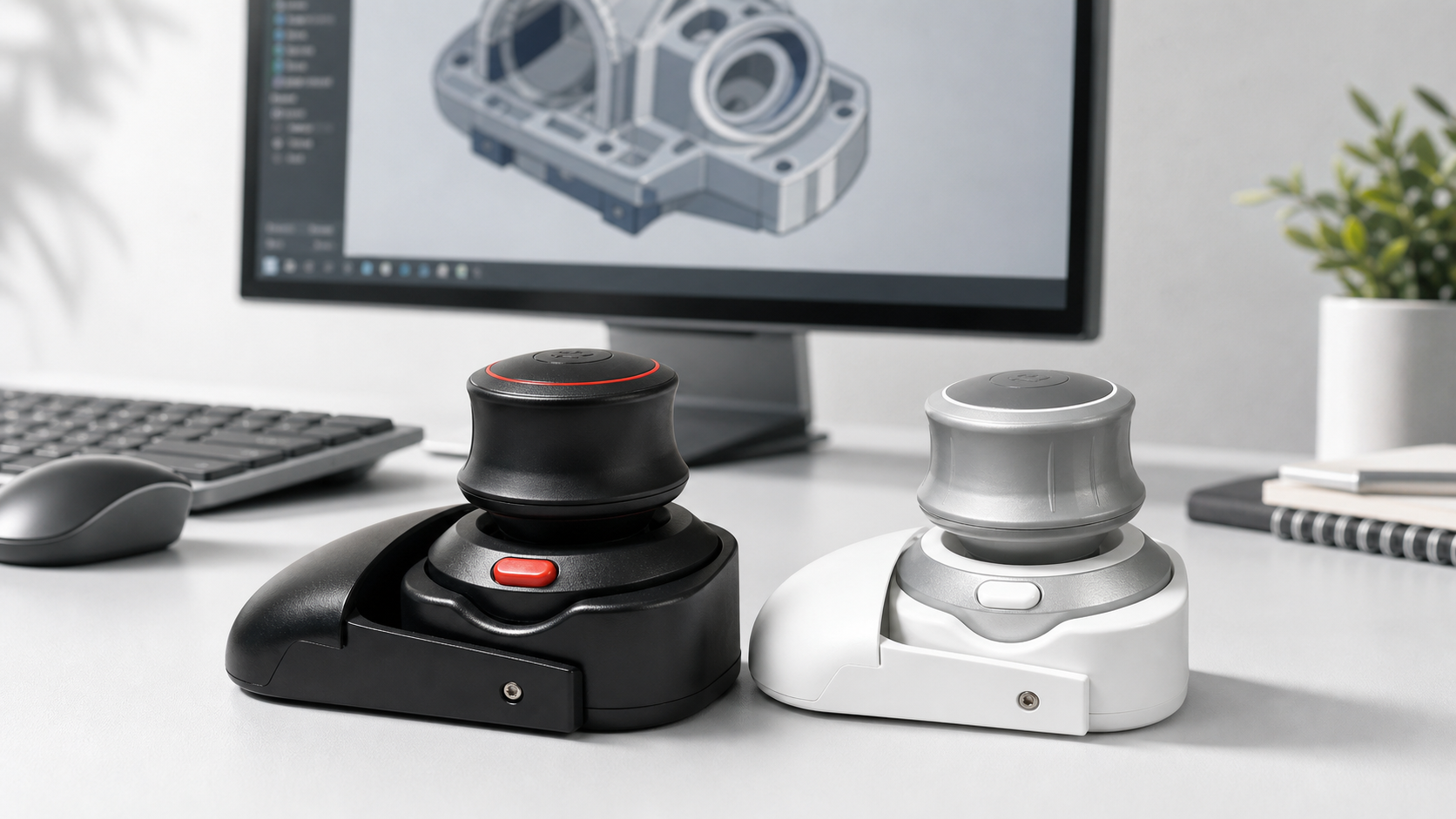
The Wireless 3D CAD Mouse is a compact option for designers who want dedicated spatial navigation beside a normal mouse, keyboard, tablet, or trackpad. The best test is a real concept review, not a blank demo model.
FAQ
Is a 3D mouse useful for industrial design?
It can be, especially when form review, surface inspection, and presentation movement happen often.
Does it replace sketching or rendering?
No. It supports navigation while you still use your normal tools for design, modeling, and output.
What products benefit most?
Small products, enclosures, handheld objects, and detailed forms benefit from smoother multi-angle review.
Should sensitivity be high for concept work?
Use moderate speed for exploration and slower settings for surface details.
Bottom line
A 3D mouse helps industrial designers when moving around form is part of thinking. It supports proportion checks, surface review, and calmer presentations, but it should be tested inside the modeling tools you actually use.