Blog
3D Mouse Terminology Explained: Pan, Orbit, Zoom, Roll, and Fly
Jul
3D mouse terminology can be confusing because different software uses similar words in slightly different ways. Pan, orbit, zoom, roll, fly, spin, rotate, tilt, and view center all describe how the camera or model moves on screen. Once you understand the basic vocabulary, setup menus and practice advice become much easier to follow.
The most useful way to learn the terms is not by memorizing definitions in isolation. Tie each word to a physical hand motion and a visible change in the model. That makes it easier to adjust settings, explain problems, and practice with purpose.
Pan means sliding the view
Pan moves the view left, right, up, or down without moving closer to the model. Imagine sliding a sheet of paper across your desk while keeping the same viewing distance. In CAD, pan is useful when the part is already at the right zoom level but the feature you need is not centered.
Beginners often confuse pan with orbit because both can move the model across the screen. The difference is that pan does not change the viewing angle. If you are looking at the front face of a part, panning keeps that same face toward you while shifting the visible area.
Orbit and rotate change the viewing angle
Orbit means moving the camera around the model or rotating the model in the viewport, depending on how the software describes it. The practical result is the same: you see another side of the object. Rotate is often used as a broader word for the same kind of angle change.
This is one of the core reasons people use a 3D mouse. Smooth orbiting helps when you need to inspect a hidden edge, check the back of a part, or understand how two components relate in an assembly. The article on what a 3D mouse is explains why this is different from normal pointer movement.
Zoom moves closer or farther
Zoom changes how close the view feels. In many programs, pushing forward moves into the model and pulling back moves out. In others, the direction may depend on driver settings or user preference. If the movement feels backwards, look for a zoom direction or axis inversion option before forcing yourself to adapt.
Good zoom control is slow and deliberate. New users often zoom too quickly, overshoot the feature, then pan and orbit to recover. Lower sensitivity makes zoom easier to control, especially during detailed inspection of holes, fillets, screw bosses, or tight clearances.
Roll, tilt, and spin are orientation changes
Roll changes the view around the line of sight, similar to tilting your head while looking at the same object. Tilt may mean pitching the view up or down, though some software uses it more loosely. Spin is a casual word that can mean fast rotation, but in CAD work fast spinning is rarely the goal.
For beginners, roll can be disorienting because the model may no longer feel level. If you keep losing orientation, use view reset, standard views, or horizon-style settings when available. The goal is not to show off movement; it is to understand the geometry.
Fly mode is different from object inspection
Fly mode usually means moving through a scene as if the camera is traveling inside it. This is common in architecture walkthroughs, game engines, VR scenes, and map exploration. Object inspection is more common in mechanical CAD, where you move around a part or assembly to examine details.
A 3D mouse can support both styles, but the best settings are often different. Fly mode may need smoother forward movement and slower turning. Mechanical inspection may need precise orbit, zoom, and rotation around a selected feature. If your work spans several programs, see how to choose a 3D mouse for CAD, Blender, and Google Earth.
How the Wireless 3D CAD Mouse fits these terms
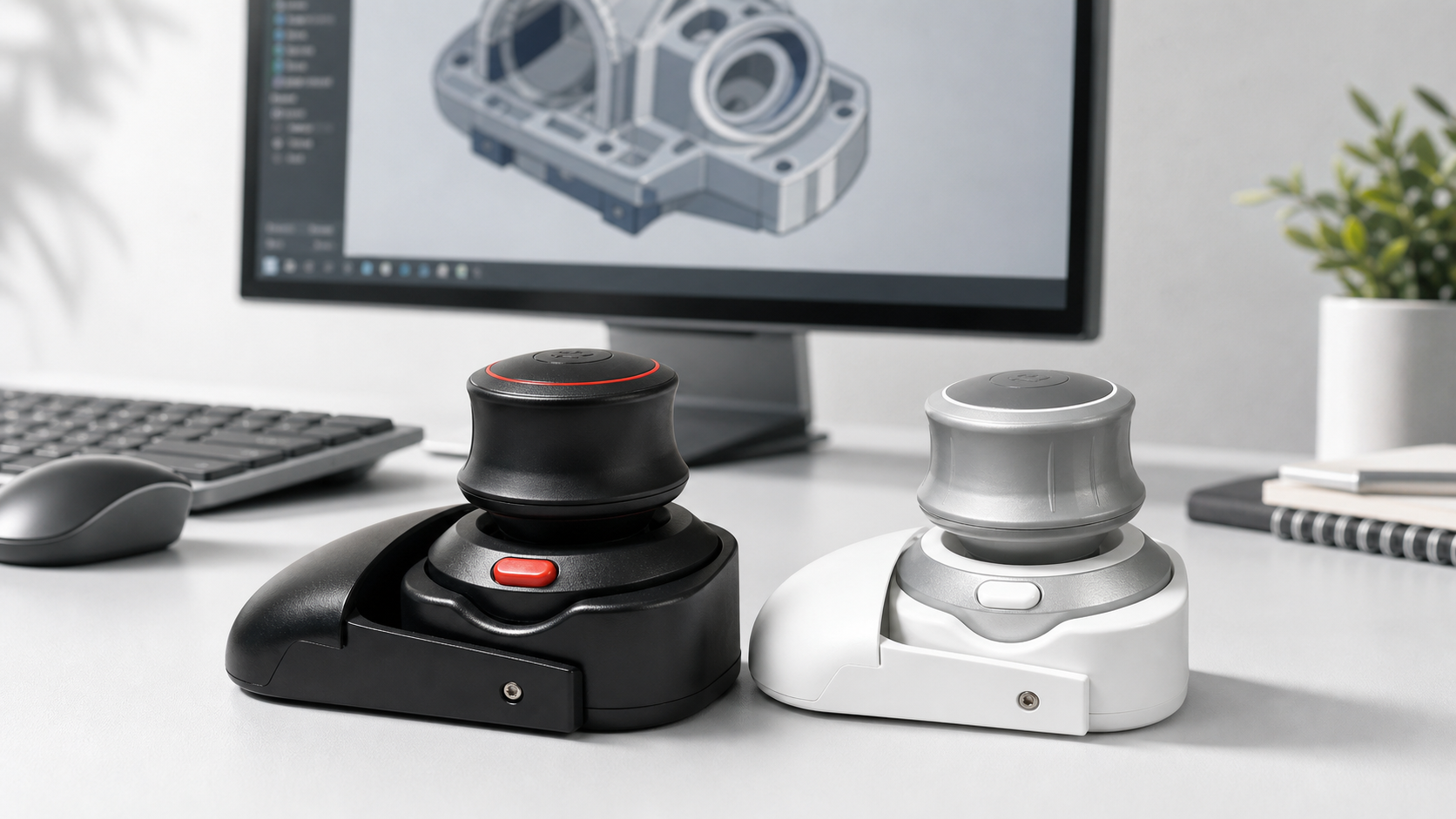
The Wireless 3D CAD Mouse should be evaluated by how well you can control these basic movements in your own software. Test pan, orbit, zoom, tilt, and roll one by one before judging advanced workflows.
If you are still learning, pair the terminology with a small practice routine. The 30-minute new 3D mouse test is a useful way to turn these words into visible behavior.
Quick reference
- Pan: slide the view without changing angle.
- Orbit or rotate: change the viewing angle around the model.
- Zoom: move closer to or farther from the model.
- Roll: rotate the view around the line of sight.
- Fly: travel through a larger scene or environment.
FAQ
Why do different programs use different words?
Each CAD, modeling, or visualization tool has its own history and interface style. The exact label may change, but the visible movement is usually easy to map once you test it.
Is orbit the same as rotate?
Often, yes in everyday use. Some programs distinguish camera orbit from object rotation, but beginners can think of both as changing the viewing angle.
What term matters most for CAD beginners?
Orbit is usually the most important because it helps you understand a part from multiple angles. Pan and zoom come next because they keep features centered and readable.
What should I do if the directions feel wrong?
Check axis inversion, zoom direction, and rotation settings. Many devices and programs let users reverse directions to match their expectations.
Takeaway
3D mouse terminology is only useful when it helps you control the view. Learn the words through movement: pan to slide, zoom to change distance, orbit to inspect angles, roll to change orientation, and fly to move through scenes. Once those basics are clear, setup advice becomes much easier to apply.