
Blog
Wireless 3D Mouse Setup: What to Check Before You Buy
Jul
A wireless 3D mouse setup should be checked before you buy, not after the box arrives. The device may be compact, but it still needs software support, stable Bluetooth, enough desk space, comfortable hand placement, and realistic expectations about what it will and will not change in your workflow.
The best pre-purchase question is simple: “Where will this sit, what program will I use it with, and what navigation problem should it solve?” If those answers are clear, the purchase is easier to evaluate. If they are vague, a wireless 3D mouse can become another gadget on the desk.
Check your software workflow first
Start with the software you use most often. CAD, 3D modeling, architecture, visualization, map, and scene tools can all behave differently. Some users need precise orbit around small mechanical features. Others need smoother movement through a larger scene. A device that feels useful in one program may feel unnecessary in another.
Write down the tasks you expect to improve: rotating a part, reviewing assemblies, checking print orientation, navigating Blender scenes, presenting models, or moving through Google Earth-style views. That list gives you something concrete to test later. If you are comparing uses across software categories, read how to choose a 3D mouse for CAD, Blender, and Google Earth.
Confirm Bluetooth and operating system expectations
Wireless setup depends on a stable connection. Before buying, check whether your computer has reliable Bluetooth, whether you prefer a direct Bluetooth connection or a dongle-style setup, and whether your operating system has the driver or settings support you need. A clean wireless desk is useful only if the connection does not add frustration.
Also think about where you work. A laptop that moves between home, classroom, office, and workshop may benefit from wireless simplicity. A fixed workstation with many USB ports may care less about wireless and more about software behavior. The right answer depends on how you actually use the machine.
Plan desk placement before judging comfort
A wireless 3D mouse still needs a stable position. Most users place it under the non-dominant hand so the regular mouse can stay under the dominant hand. If the device sits too far away, your wrist and shoulder may work harder than they should. If it sits too close to the keyboard, it may interfere with shortcuts.
Mock up the setup before buying. Put a small object where the device would sit and move between keyboard, normal mouse, and that object for a minute. If the placement feels cramped, solve the desk layout first. For compact desk ideas, see 3D mouse desk setup for small workstations.
Decide what “success” means
Do not judge a wireless 3D mouse by whether it makes everything faster on the first day. Better success criteria are more practical: fewer lost views, smoother model inspection, cleaner presentations, less repeated scroll-wheel navigation, and easier two-handed work.
Pick one real project as the test case. A known assembly, printable part, enclosure, product model, or classroom scene is better than an empty cube. If you can compare a real session before and after setup, you will know whether the device helps your actual work rather than just looking interesting.
Where the Wireless 3D CAD Mouse fits
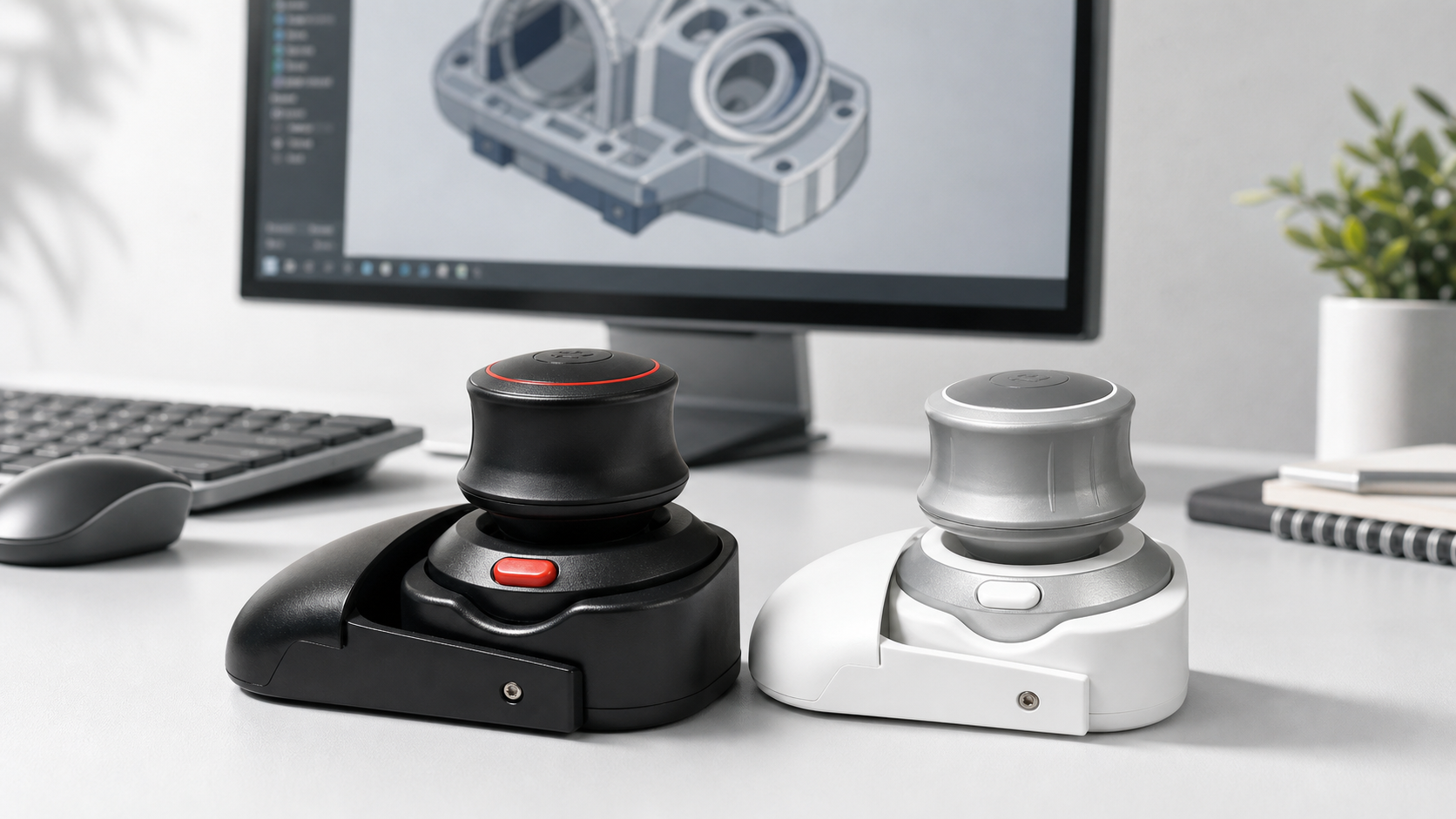
The Wireless 3D CAD Mouse is a compact Bluetooth controller for users who want dedicated 3D navigation without a large desktop footprint. That makes it most relevant for laptop CAD setups, small workstations, student desks, and users who want the normal mouse free for selection.
Use it as a navigation test, not a promise that every CAD task will transform overnight. Pair it, place it comfortably, lower sensitivity if needed, and try a familiar model first. If you need a structured post-purchase check, follow the 30-minute new 3D mouse test.
Pre-purchase checklist
- Name the main software where you expect to use it.
- Check Bluetooth reliability and operating system support.
- Choose left-side or right-side placement before buying.
- Confirm that your desk has a stable reachable area.
- Pick one real project for the first-week evaluation.
FAQ
Is wireless better than wired for a 3D mouse?
Wireless is better if clean placement, portability, and laptop use matter. Wired can still be fine for a fixed desk where cable clutter is not a problem.
Can Bluetooth lag ruin CAD navigation?
A poor connection can make navigation feel less predictable. Test Bluetooth stability on your machine and keep the device close enough for a reliable connection.
Should I buy before checking software support?
No. Your main software workflow is the first gate. If you cannot use the device where you spend the most time, the purchase is hard to justify.
What is the best first project for testing?
Choose a model you already know: a bracket, enclosure, small assembly, 3D print design, or product concept. Familiar geometry makes the device easier to judge.
Setup verdict
A wireless 3D mouse is easiest to evaluate when the setup plan is clear before purchase. Confirm software, connection, desk placement, and the test project first. Then judge the device by real navigation comfort rather than first-day novelty.