
Blog
Fusion 360 Navigation Workflow With a 3D Mouse
Jul
A good Fusion 360 3D mouse workflow starts with restraint. The controller should help you move through the design, not turn every modeling session into constant spinning. The best setup keeps navigation in one hand, precise selection in the other, and keyboard shortcuts available for commands you already know.
Think of the 3D mouse as a viewport partner. It helps you inspect the model between actions, while Fusion 360 tools still do the actual design work. If you are new to this style, it is worth reading a broader beginner guide to 3D mouse CAD navigation before tuning Fusion-specific habits.
A sample workflow from sketch to inspection
Start with a simple sketch. Use the regular mouse and keyboard for dimensions, constraints, and profiles. At this stage, the 3D mouse only needs to help you reframe the view. Do not overuse it while drawing precise sketch geometry.
Once you extrude the sketch into a body, navigation becomes more valuable. Orbit around the part to inspect the first solid form. Zoom into the edges you plan to fillet. Pan to compare the front and side. When you add features, use the 3D mouse to check whether the geometry looks correct from several angles before moving on.
During body inspection, slow down. Small parts can become confusing when over-rotated. Use controlled orbiting, pause before selection, and keep the feature you care about near the center of the screen.
Where keyboard shortcuts still belong
Do not move common commands onto the 3D mouse just because buttons exist. If a shortcut is already automatic, keep it on the keyboard. Sketch tools, timeline actions, selection filters, view recovery commands, and command search may be faster in their normal place.
The most reliable rhythm is simple: navigate with the 3D mouse, select and edit with the regular mouse, trigger known commands with the keyboard. That division keeps the setup easy to learn and easier to troubleshoot.
Beginner mistakes to avoid
The first mistake is sensitivity that is too high. Fast movement feels exciting for a minute, then becomes tiring when checking small parts. The second mistake is rotating while trying to select tiny geometry. Move first, stop, then select. The third mistake is testing on a blank model. Use a real part with holes, fillets, faces, and edges.
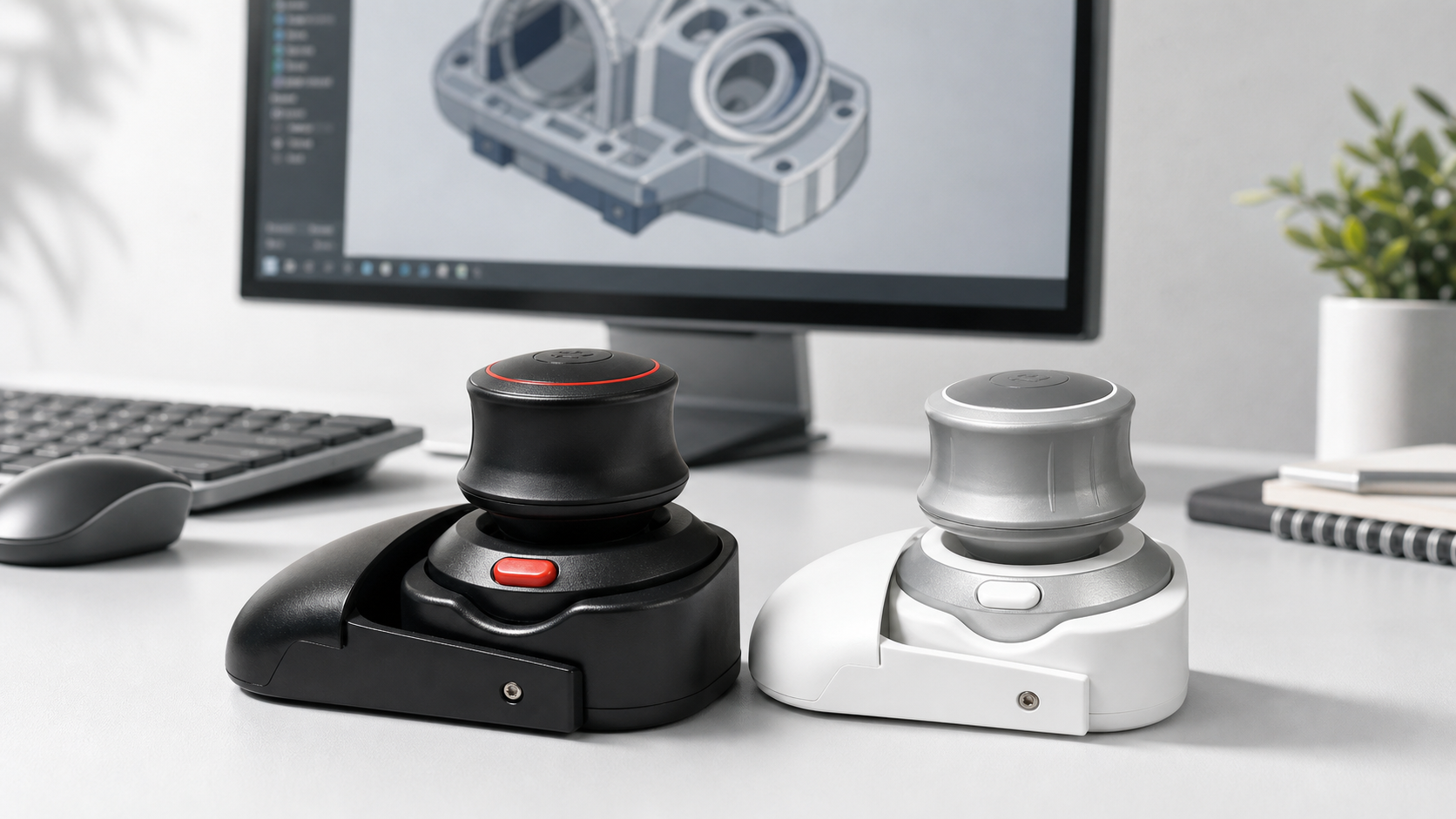
The Wireless 3D CAD Mouse can fit this setup as a compact Bluetooth controller for general CAD navigation. Use it with a normal mouse and keyboard, then verify Fusion 360 behavior on your operating system before relying on it for production work.
FAQ
Should I use the 3D mouse during sketching?
Use it lightly. Sketching depends more on precision, constraints, dimensions, and regular mouse input.
How do I avoid over-rotating small parts?
Lower sensitivity, keep the feature centered, and pause before selecting geometry.
Can keyboard shortcuts stay in the workflow?
Yes. In most cases they should. The 3D mouse handles view movement, not every command.
What is a good first practice model?
Use a small bracket, enclosure, or mechanical part with holes, fillets, and multiple faces to inspect.
Bottom line
A Fusion 360 3D mouse workflow works best when each input device has a clear job. Keep the controller focused on smooth view movement, and let the regular tools continue handling design decisions.