
Blog
3D Mouse for SolidWorks Users: Buying and Workflow Notes
Jul
SolidWorks users tend to care about a 3D mouse for a practical reason: they spend a lot of time inspecting 3D geometry. Parts, assemblies, drawings, section views, and design reviews all require repeated view changes. A dedicated navigation controller can reduce the friction of those small camera movements.
That does not mean every SolidWorks user needs one. If you open a model occasionally, a normal mouse and shortcuts may be enough. If you work in mechanical design every week, the value of a less tiring CAD navigation setup becomes easier to feel.
Part modeling workflow
During part modeling, a 3D mouse helps most when you need to inspect features from several angles. Holes, ribs, fillets, chamfers, bosses, and thin walls can look correct from one side and wrong from another. Smooth orbiting makes it easier to check the shape before you commit to the next feature.
The trick is not to rotate constantly. Move the part into a useful view, pause, select or edit with the regular mouse, then move again. This keeps navigation helpful instead of distracting.
Assembly and drawing review
Assemblies are where dedicated navigation often feels more valuable. You may need to check fit, clearance, mates, interference areas, fastener access, or component relationships. Smooth orbit and pan make that review less choppy, especially when discussing the model with another person.
For drawings, the benefit is different. A 3D mouse will not replace drawing tools, but it can help when moving between the drawing and the 3D model during review. Engineers often need to confirm that a view, section, or detail matches the part intent.
What to verify before buying
Before expecting software-specific button mapping, verify what the device supports in your actual SolidWorks environment. Check your operating system, driver requirements, navigation behavior, button configuration, and return policy. Also decide whether you mainly need spatial navigation or advanced macro/button workflows.
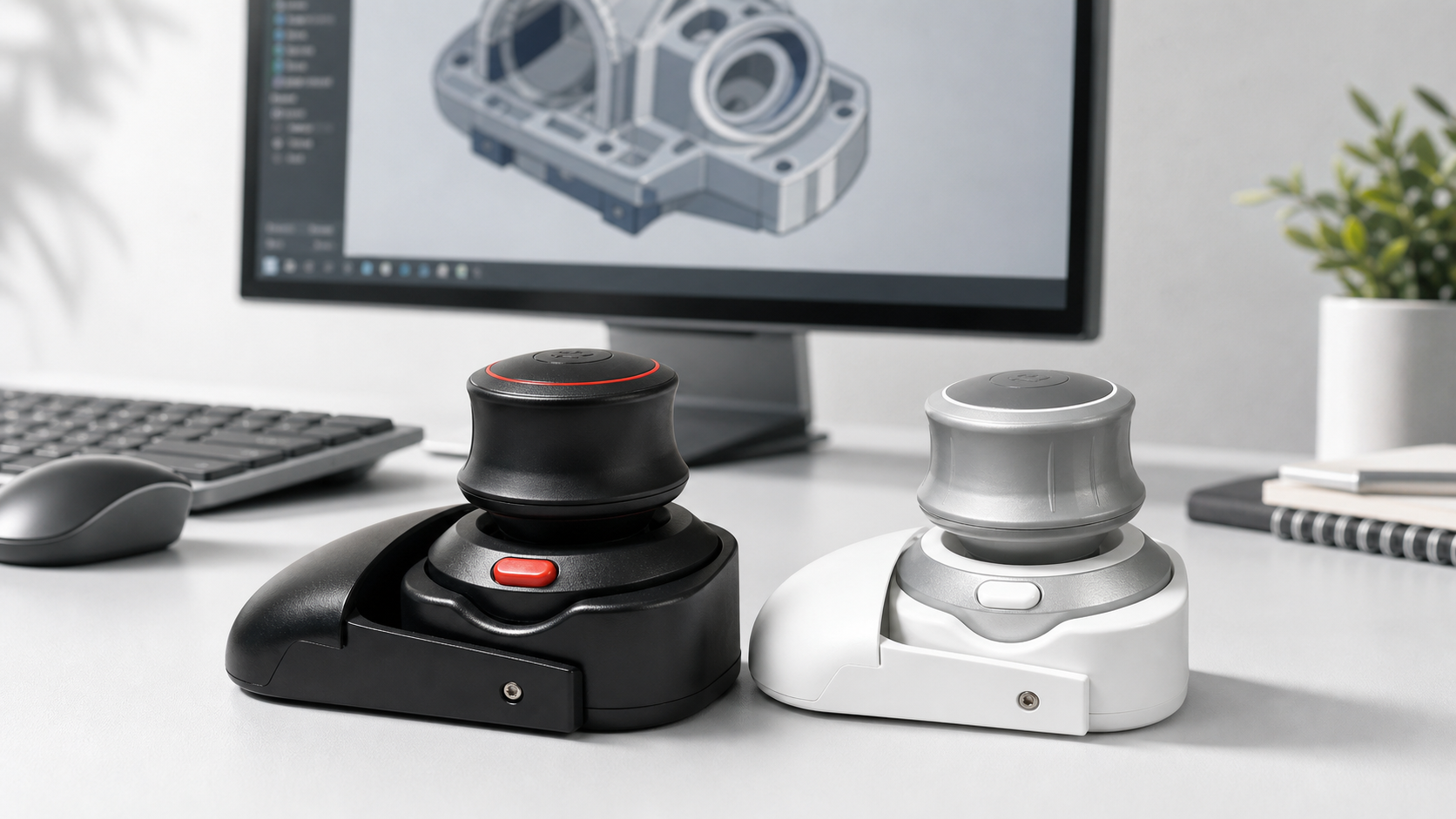
The Wireless 3D CAD Mouse is positioned as an affordable general CAD navigation controller rather than a high-end command console. At $129, it makes sense for users who want compact Bluetooth 3D navigation for SolidWorks-style work, while still keeping a normal mouse and keyboard in the center of the workflow.
Who gets the most value
Frequent SolidWorks users get the most value: mechanical designers, product engineers, students doing complex projects, and small teams reviewing assemblies. Occasional users should test carefully before buying, because the learning curve is real and the benefit depends on how often you navigate in 3D.
FAQ
Is a 3D mouse worth it for SolidWorks assemblies?
It can be, especially when you inspect fit, clearances, mates, and component relationships often.
Will it replace my normal mouse?
No. The normal mouse remains important for selection, menus, sketches, and feature work.
Do I need advanced button mapping?
Not always. Many users benefit mainly from smooth navigation. Verify button expectations before buying.
Is it useful for drawings?
It can support model checks during drawing review, but it does not replace drawing commands.
Bottom line
A 3D mouse for SolidWorks is most convincing when 3D review is part of daily work. If assemblies, parts, and model checks fill your week, dedicated navigation can be a sensible upgrade.