
Blog
3D Mouse for Autodesk Inventor: Assembly Navigation Guide
Jul
Autodesk Inventor users often work with parts, assemblies, drawings, and mechanical checks that require repeated viewpoint changes. A 3D mouse can help when the model itself needs to be inspected from several angles, especially in assemblies where fit and clearance matter and small hidden details can change a design decision.
The device should not replace Inventor commands. It should make spatial review easier while the normal mouse and keyboard continue handling selection, features, constraints, drawings, and known shortcuts.
Navigation across parts and assemblies
For individual parts, a 3D mouse helps when checking features such as holes, ribs, fillets, pockets, chamfers, and thin sections. A small rotation can reveal a modeling issue that a fixed view hides. The benefit is strongest when you inspect geometry often instead of only creating simple features.
Assemblies usually make the case stronger. Inventor users may need to check clearances, component relationships, fastener access, interference areas, and movement paths. Smooth navigation lets you center the area under review and move around it without constantly switching view controls.
Drawing review still needs normal tools
Drawings are a different workflow. A 3D mouse may help when jumping back to the model for context, but annotation, dimensions, views, and drawing edits still live in the standard Inventor toolset. Keep that separation clear so the controller does not become a distraction.
If your main work is drawing cleanup, the upgrade may not feel urgent. If your drawings are tied to frequent model checks, the navigation support becomes more relevant.
Precise viewpoint control for mechanical checks
Mechanical design often depends on small details. Can a fastener be installed? Is a bracket accessible? Does a moving part have space? Is an imported component aligned correctly? A 3D mouse helps when you need controlled viewpoint changes around those details.
The same logic appears in assembly review workflows across CAD tools. The software changes, but the need for calm inspection stays familiar.
Setup and device fit
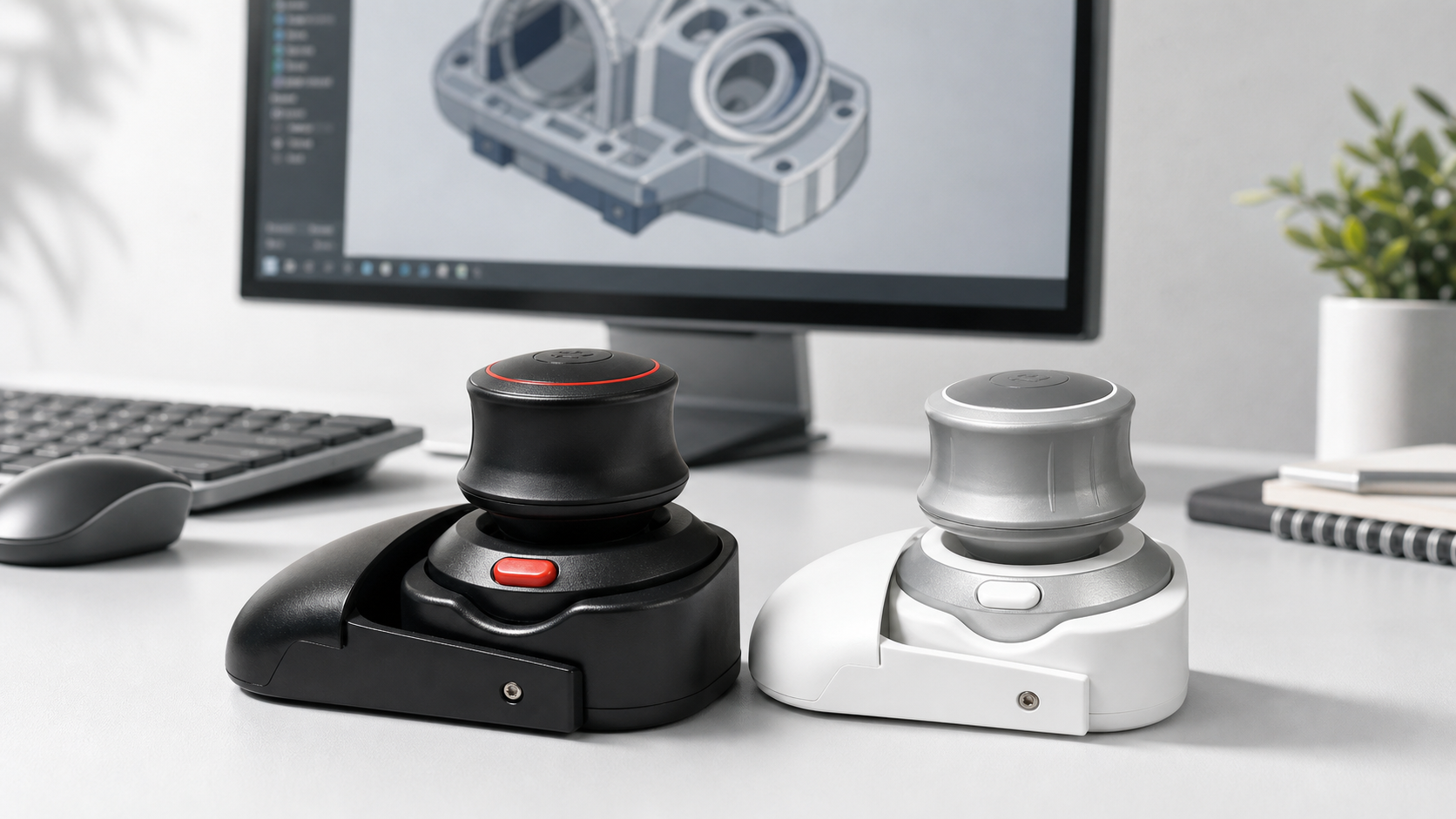
Before buying, check driver support, operating system behavior, sensitivity controls, axis direction, and return policy. The Wireless 3D CAD Mouse can fit after that check as a compact Bluetooth controller for general CAD navigation. It sells for $129 and works best when the buyer mainly needs spatial movement rather than a large button-heavy command surface.
FAQ
Is a 3D mouse useful for Inventor assemblies?
Yes, especially for reviewing clearances, fastener access, component fit, and interference areas.
Does it replace Inventor shortcuts?
No. Shortcuts, commands, constraints, and normal mouse selection remain important.
Should drawing-heavy users buy one?
Only if drawing work is tied to frequent 3D model checks. Pure documentation work may not benefit much.
What should I verify first?
Verify driver support, operating system behavior, sensitivity, axis direction, and Inventor workflow fit.
Bottom line
A 3D mouse for Inventor makes the most sense for mechanical review, assembly navigation, and frequent model inspection. It is a navigation upgrade, not a replacement for Inventor skill, careful constraints, or a clear engineering review process with documented decisions and real design context.