
Blog
How to Test a New 3D Mouse in 30 Minutes
Jul
A new 3D mouse can feel impressive in the first minute and confusing in the next ten. The best way to judge it is not to spin a demo model for a few seconds. Give it a short, repeatable test that covers pairing, movement, comfort, software focus, and one real task from your own work.
This 30-minute test is meant for CAD users, Blender users, students, and designers who want a clear first impression without turning setup day into a full troubleshooting project. Keep your normal mouse and keyboard nearby, because a 3D mouse is usually a second-hand navigation tool, not a total replacement.
Minute 0 to 5: confirm pairing and app focus
Start with the boring checks. Charge or power the device, pair it through Bluetooth, and confirm that your operating system sees it. Open only one target application at first. If five design apps are running, you will not know whether the device, the driver, or the active window is responsible for odd behavior.
Move the cap gently in each direction: pan, zoom, orbit, tilt, and roll if your software supports it. Do not judge speed yet. This first block only proves that input reaches the software. If the device does not respond, use the beginner checklist in 3D mouse not working troubleshooting before changing deeper settings.
Minute 5 to 15: use one simple CAD part
Choose a familiar part with clear faces, edges, holes, and details. Your task is to inspect it slowly. Orbit around the front, zoom into one detail, pan across the model, and return to a known view. Good navigation should feel controlled enough that you can stop where you intended.
If the view overshoots, reduce sensitivity before blaming the device. If one direction feels backwards, note it but keep testing. Axis direction is partly personal, and it often becomes clearer after a few minutes of use.
Minute 15 to 23: try a larger scene
Next, test a larger assembly, a Blender scene, or a Google Earth style navigation session. Big scenes reveal a different question: does the controller help you travel through space smoothly, or does it make the camera feel jumpy?
This block also exposes graphics lag. If the model stutters only when the file is heavy, the issue may be rendering performance rather than the 3D mouse itself. Test one light file and one heavier file so you can separate input feel from computer load.
Minute 23 to 30: comfort and decision notes
Spend the final minutes on hand position. Can your non-dominant hand rest naturally? Does the device crowd your keyboard? Can your regular mouse still handle selection comfortably? A compact controller is valuable only if it fits the desk you actually use.
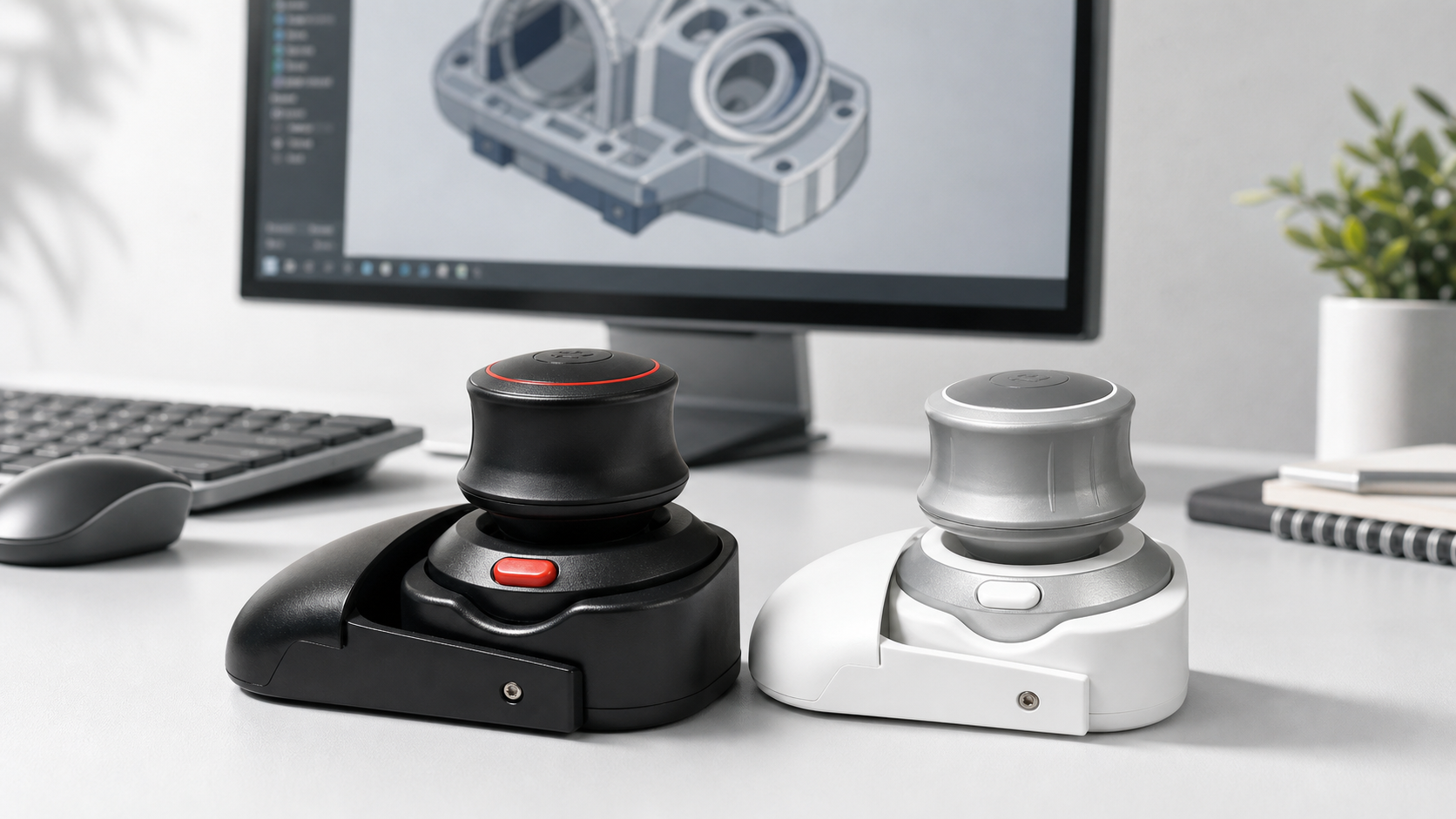
The Wireless 3D CAD Mouse is designed as a compact Bluetooth option for CAD, 3D modeling, Blender workflows, VR scene navigation, and Google Earth style movement. In a first test, judge it by whether it makes repeated navigation calmer, not by whether it instantly makes you faster.
FAQ
Should I test in CAD or a demo app first?
Test in the real software you plan to use. Demo scenes can be helpful, but they do not prove value in your daily workflow.
What if the mouse feels too sensitive?
Lower sensitivity and test again with a small model. Many first impressions improve once speed is reduced.
Should I learn shortcuts before testing?
Basic shortcuts still matter. The 3D mouse should handle view movement while the keyboard handles commands you use often.
Is 30 minutes enough to decide?
It is enough for a first pass. Use the result to decide whether the device deserves a longer one-week trial.
Bottom line
A good 30-minute test gives you evidence: pairing works, motion feels controllable, large scenes behave acceptably, and the desk setup makes sense. If those checks pass, continue testing in real projects. If they fail, fix the specific blocker before deciding the device is wrong for you.