Blog
3D Mouse Shortcuts: What Should Stay on the Keyboard?
Jul
A 3D mouse changes how you move through a model, but it should not make you abandon every keyboard shortcut. The strongest CAD setups divide work clearly: one hand controls the view, the regular mouse selects and edits, and the keyboard still handles commands that are faster as shortcuts.
Problems begin when users expect a navigation controller to replace software fluency. It can make orbit, pan, zoom, and inspection smoother, but it does not remove the need to know your core tools.
Keep command shortcuts on the keyboard
Commands like save, undo, sketch, extrude, measure, isolate, fit view, and search are often faster on the keyboard. If you already know those shortcuts, keep them. Muscle memory is valuable, and replacing it too quickly can slow you down.
A 3D mouse is most useful when it reduces view friction. Let it handle the motion that interrupts modeling flow. Let the keyboard handle commands that already work well.
Use the regular mouse for selection
Most users still need the normal mouse for picking faces, selecting edges, dragging handles, editing dimensions, and using menus. The 3D mouse should not fight that role. A good two-hand workflow lets the selection hand stay precise while the navigation hand adjusts the view.
If you are new to that split, read two-handed CAD workflow with a 3D mouse and practice slowly before changing your entire setup.
Move only repeated navigation away from shortcuts
Some view shortcuts may become less important after you adopt a 3D mouse. Manual orbit, pan, zoom, rotate view, and view alignment can shift toward the controller, especially during model review.
Do not remove a shortcut just because the controller can do something similar. Keep whichever method is faster, clearer, and less tiring in the task you actually repeat.
Build a small personal map
Write down three lists: shortcuts you will keep, navigation actions you will move to the 3D mouse, and commands you are still testing. This simple map prevents setup churn. It also helps if you work across CAD, Blender, and browser tools with different shortcut behavior.
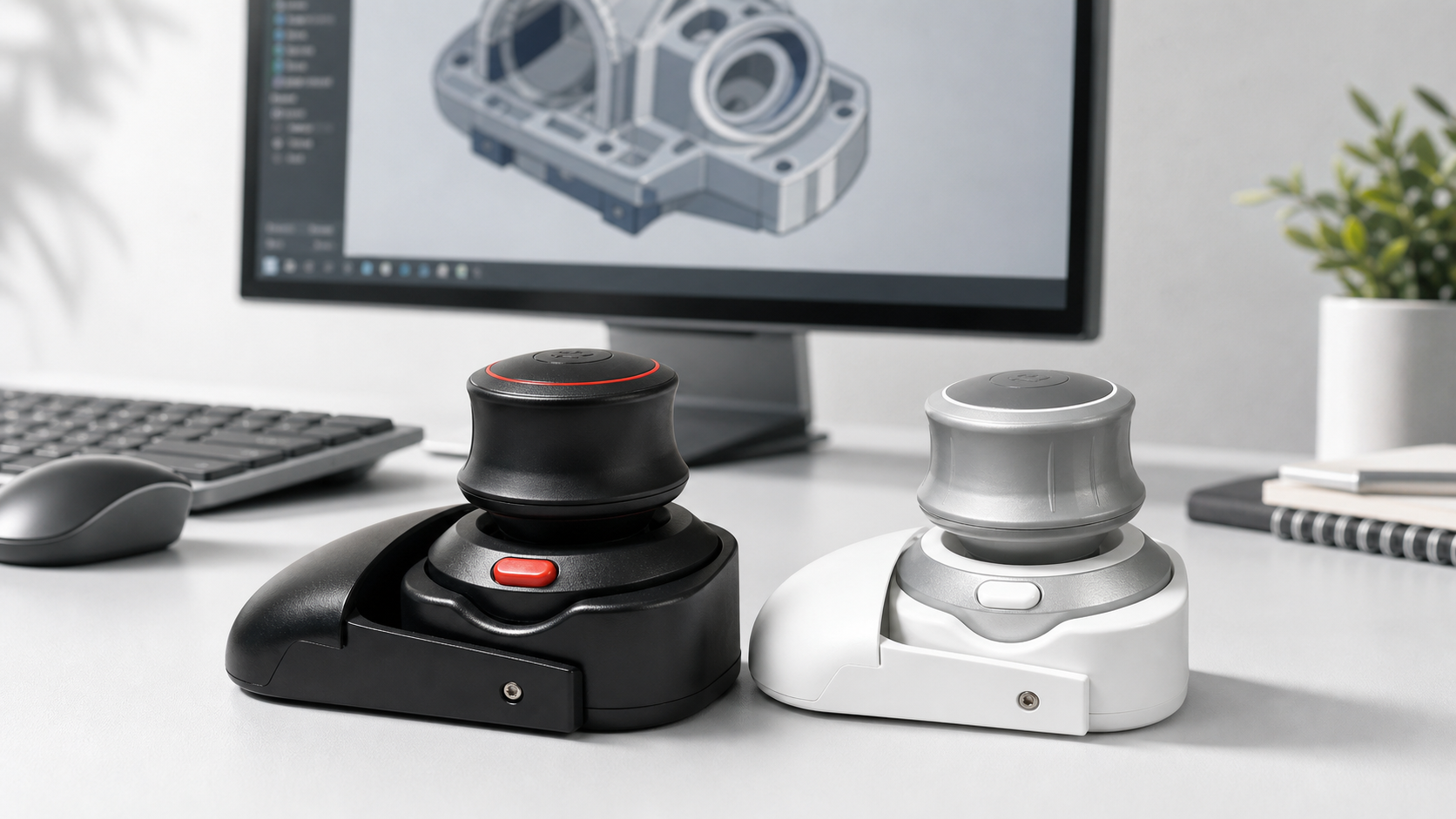
The Wireless 3D CAD Mouse fits best as a dedicated spatial navigation controller alongside your keyboard and regular mouse. Think of it as adding a navigation hand, not deleting the rest of the workstation.
FAQ
Can a 3D mouse replace keyboard shortcuts?
Not completely. It can reduce view-navigation shortcuts, but core commands usually stay faster on the keyboard.
Should beginners buy a 3D mouse before learning shortcuts?
Learn essential commands first, then add the controller when view movement becomes a repeated pain.
What shortcuts matter most?
Save, undo, measure, sketch, feature commands, fit view, and search are usually worth keeping.
How do I avoid setup confusion?
Change one habit at a time and keep a short list of what each hand is responsible for.
Bottom line
The best shortcut strategy is not all keyboard or all 3D mouse. It is a clean division of labor. Keep command fluency, use the controller for repeated spatial movement, and let each tool do the job it handles best.