
Blog
3D Mouse for Industrial Design Form Review
Jul
Industrial design depends on form judgment. A product can look balanced from the front and awkward from the rear. A handle can feel elegant from one angle and heavy from another. A 3D mouse can help during form review because it makes rotating around a product feel smoother and less disruptive.
This is not only about modeling speed. Many design decisions happen while looking: checking proportions, surface flow, silhouette, edge breaks, and how the object will be presented. Smooth navigation supports that review phase.
Many angles reveal design issues
Product form is three-dimensional, so one hero view can be misleading. Rotate around the model slowly and watch where the silhouette changes. Check whether the object still feels balanced from high, low, front, rear, and three-quarter views.
This kind of review is useful for consumer products, enclosures, tools, furniture, vehicles, accessories, and small objects. It also helps when comparing several design revisions. Smooth motion makes differences easier to see because the view changes gradually instead of jumping.
Surface flow and proportions
Surface modeling is full of subtle problems. A transition may look clean in one view and pinched in another. A fillet may feel too heavy when the model is rotated. A seam, parting line, vent, or button may interrupt the form more than expected.
Industrial designers using Rhino, Fusion 360, Blender, or CAD tools can pair navigation review with more focused software checks. The same idea appears in Rhino smooth surface modeling navigation.
Review quality, not just speed
Fast navigation can hide design issues. Slow orbiting is usually better for form critique. Pause on important angles, take screenshots, compare revisions, and ask whether the product still communicates the intended character.
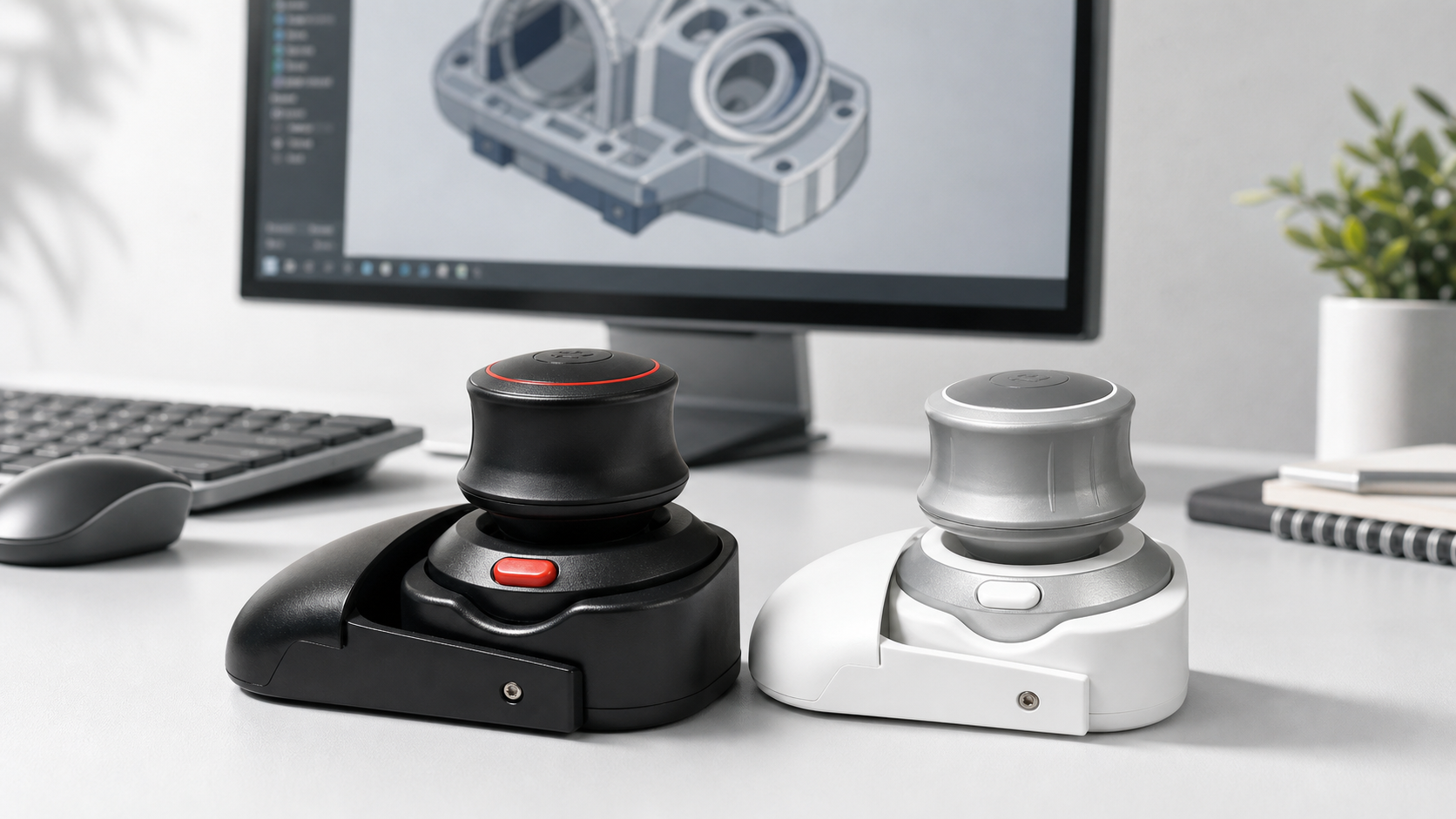
The Wireless 3D CAD Mouse fits a product designer setup as a compact Bluetooth navigation controller. It can sit beside a normal mouse and keyboard while the designer uses the main input tools for selection, modeling, and editing.
Presentation angles
Form review also prepares presentations. When you know which angles reveal the product best, you can plan renders, client walkthroughs, portfolio images, or design review screenshots more confidently. A navigation device helps you explore those angles quickly, but the final judgment still belongs to the designer.
It can also help during team critique. One person can guide the model through consistent angles while the team discusses proportion, usability, manufacturing constraints, and visual character. That shared view keeps comments tied to the same geometry.
FAQ
Does a 3D mouse make industrial design better?
Not by itself. It helps you inspect form, but better design still requires taste, iteration, and critique.
Which models benefit most?
Products with curved surfaces, ergonomic forms, visible seams, and important presentation angles benefit most.
Should movement be fast or slow?
Slow movement is better for critique. Fast movement can hide surface and proportion problems.
Can it help with portfolio work?
Yes. It can help find strong angles for screenshots, renders, and model walkthroughs.
Bottom line
A 3D mouse for industrial design is a review tool. It helps designers study form from many angles and make calmer decisions about surface, proportion, and presentation.