
Blog
Should You Buy a 3D Mouse Before Learning CAD Shortcuts?
Jul
Most beginners should learn core CAD shortcuts before buying a 3D mouse. Shortcuts and navigation accessories solve different problems, but command speed is part of the foundation. If you do not know how to select, constrain, sketch, view, undo, save, and recover views efficiently, hardware will not fix the workflow.
That does not mean a 3D mouse is a bad upgrade. It means the upgrade makes more sense after the basics are stable and viewport movement has become a real bottleneck.
Shortcuts solve command speed
CAD shortcuts help with commands, selection modes, view recovery, dimensions, feature tools, and repeated actions. They reduce time spent hunting through menus. A beginner who learns a few essential shortcuts often improves faster than a beginner who buys another device immediately.
Shortcuts also make troubleshooting easier. When a view gets lost or a command goes wrong, basic keyboard habits help you recover without panic.
3D mice solve navigation friction
A 3D mouse helps when the problem is spatial movement: orbiting around parts, panning across assemblies, zooming into details, presenting models, or reviewing 3D geometry for long sessions. It is not primarily a command-speed tool.
Once navigation becomes a repeated frustration, a controller can complete the setup. The broader beginner guide to CAD navigation with a 3D mouse is a good next step.
When adding one makes sense
Add a 3D mouse when you already know the basic commands but still feel slowed down by view movement. This often happens when beginners move from simple sketches to bodies, assemblies, 3D printing checks, architecture models, or product reviews.
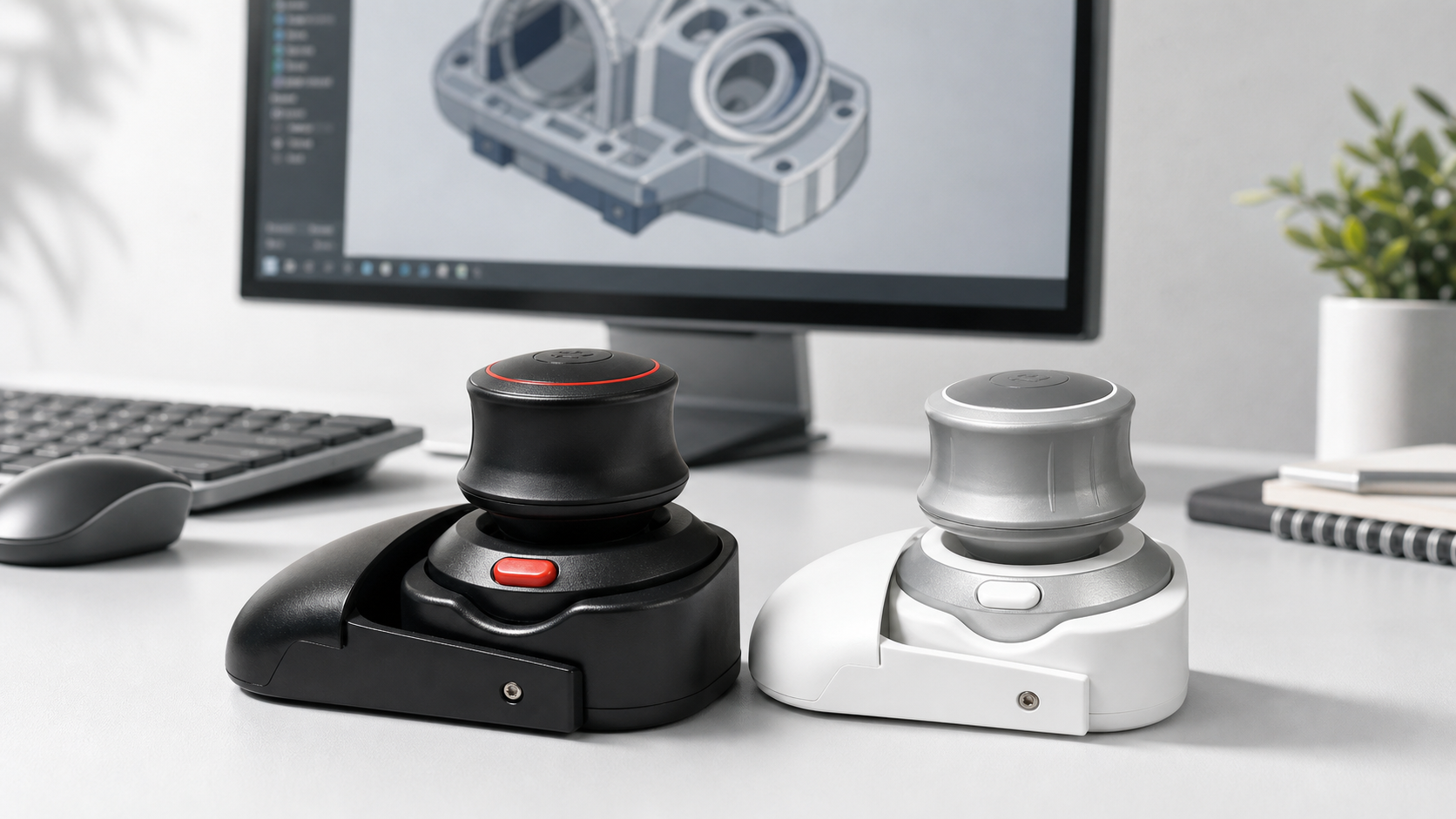
The Wireless 3D CAD Mouse is best positioned as an upgrade after workflow basics are stable. It gives a compact Bluetooth navigation controller to users who already know why they need smoother 3D movement.
A fair learning path
First, learn the core shortcuts in your main software. Second, practice normal viewport navigation. Third, note when navigation interrupts you. Fourth, test a 3D mouse with real projects. That order keeps the purchase grounded.
A good beginner milestone is simple: you should be able to open a file, recover a lost view, create basic geometry, undo safely, save confidently, and inspect the model without asking where every command lives. Once that foundation feels steady, a 3D mouse becomes an upgrade instead of a distraction.
This order also makes testing easier. A beginner who knows the basic workflow can judge whether the device improves navigation. A beginner who is still lost in commands may blame the wrong tool for normal learning friction.
FAQ
Should absolute beginners buy a 3D mouse first?
Usually no. Learn core CAD shortcuts and basic navigation first.
Do shortcuts and 3D mice overlap?
Only partly. Shortcuts speed commands, while 3D mice improve spatial navigation.
When is the upgrade worth it?
When 3D model review, orbiting, panning, and zooming become frequent workflow interruptions.
Can a 3D mouse hide weak fundamentals?
It can distract from fundamentals if bought too early. Use it after basic habits are solid.
Bottom line
Learn CAD shortcuts first, then consider a 3D mouse when navigation becomes the clear bottleneck. Hardware works best after the workflow has a foundation.