
Blog
3D Mouse vs Trackball for CAD Users
Jul
A 3D mouse and a trackball are both CAD mouse alternatives, but they are not the same kind of tool. A trackball changes cursor control. A 3D mouse changes viewport navigation. CAD users should compare the problem they are trying to solve before buying either one.
If your hand hurts from moving a normal mouse, a trackball may help. If the issue is constantly orbiting, panning, and zooming through 3D models, a 3D mouse is more directly related.
Cursor control and hand comfort
A trackball lets you move the cursor without moving the whole device across the desk. Some users love this for comfort, space savings, and reduced arm movement. It can be useful for selection, drafting, menus, and general computer work.
But a trackball is still mainly a pointer device. It does not automatically create the same two-handed 3D navigation workflow as a dedicated spatial controller.
Viewport navigation
A 3D mouse focuses on orbit, pan, zoom, and model inspection. It sits beside the normal cursor device and lets one hand move the view while the other hand selects or edits. That can be useful for assemblies, product models, architecture views, and 3D scene review.
This is why some users may use both: a trackball for cursor comfort and a 3D mouse for navigation. The setup only makes sense if the desk has room and the user actually benefits from both roles.
Desk space and learning curve
Trackballs can save mouse movement space, but they still need a comfortable position. A 3D mouse adds a second device, so small desks require planning. Learning curve matters too. Trackballs feel strange to some users at first; 3D mice require practice with speed and axis control.
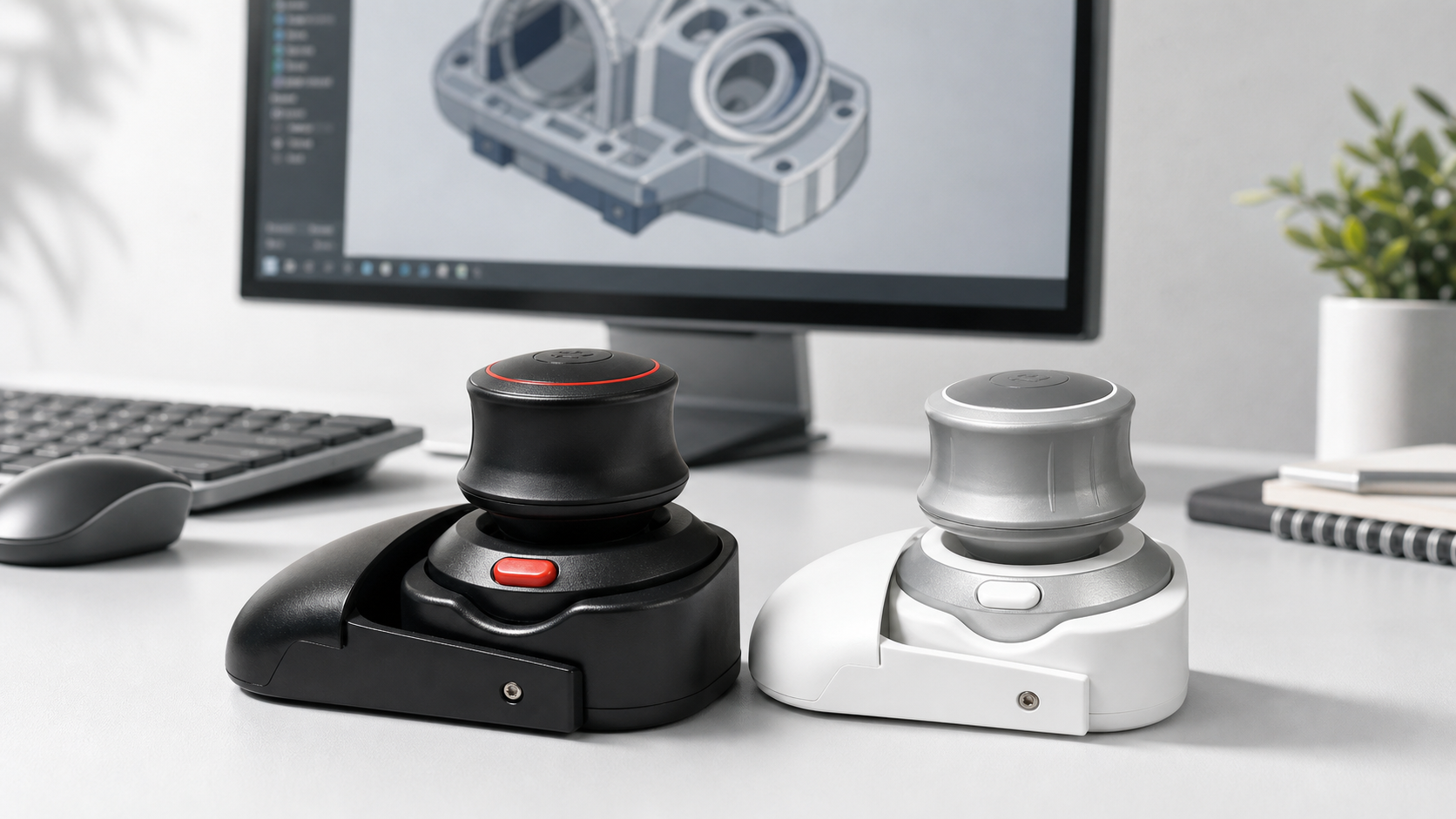
The Wireless 3D CAD Mouse is the dedicated 3D navigation choice in this comparison. It is not trying to replace a trackball; it addresses the viewport side of CAD and 3D modeling work. For desk planning, see the compact 3D mouse buying guide.
One fair test is to name the pain before shopping. If the pain is wrist movement from cursor work, test a trackball. If the pain is repeated model rotation and inspection, test a 3D mouse. If both pains are real, a combined setup may be reasonable, but only after confirming the desk stays comfortable.
Also consider the work rhythm. Trackballs are used constantly for cursor movement. A 3D mouse is used in bursts during spatial review. If you dislike switching hand roles, a simpler setup may be better even if both devices sound useful.
FAQ
Is a trackball better for CAD?
It can be better for cursor comfort, but not necessarily for 3D viewport navigation.
Can I use both?
Yes, if each device has a clear role and the desk has enough space.
Which has the bigger learning curve?
Both take practice. Trackballs change pointer habits; 3D mice change navigation habits.
Which should I buy first?
Buy for the problem you feel most: cursor comfort or 3D model navigation.
Bottom line
A 3D mouse versus trackball decision starts with the task. Choose a trackball for cursor comfort and a 3D mouse for dedicated spatial navigation.